The amendments to reporting deadlines were published in the official journal on 8 January 2025. These changes generally extend most submission deadlines for both solo and group entities. The previous six-week extension for all group reporting deadlines has been removed, with the updated directive now providing clear, specific deadlines for group reporting.
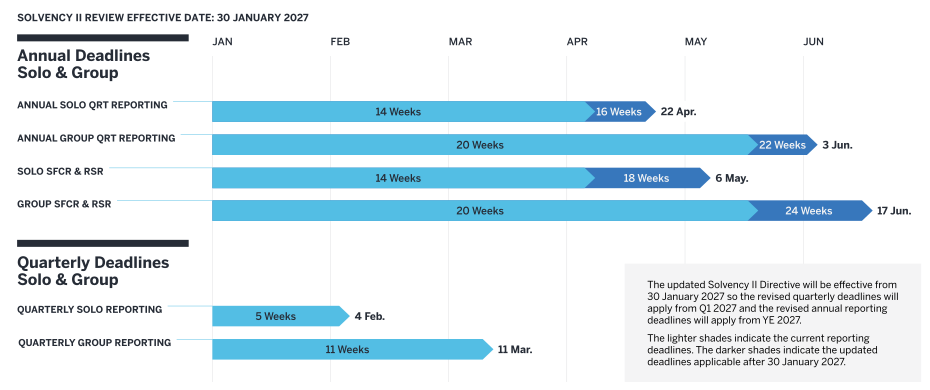
You will see in our calendar (downloadable here) that the Solvency II (SII) review has made the following updates to reporting deadlines—please note that the lighter shades indicate the current deadlines, whereas the darker shades indicate the updated deadlines applicable after 30 January 2027. It is important to note that due to the implementation date of 30 January 2027, the quarterly deadlines will apply from Q1 2027; however, the annual reporting extensions will not apply until year-end 2027.
Solo reporting
- Quarterly quantitative reporting templates (QRTs): Deadlines remain unchanged at five weeks.
- Annual QRTs: extended by two weeks; now due within 16 weeks of year-end (previously 14 weeks).
- Solvency and financial condition report (SFCR) and regular supervisory report (RSR): extended by four weeks; now due within 18 weeks of year-end (previously 14 weeks).
Group reporting
- Quarterly QRTs: Deadlines remain unchanged at 11 weeks.
- Annual QRTs: extended by two weeks; now due within 22 weeks of year-end (previously 20 weeks).
- SFCR and RSR: extended by four weeks; now due within 24 weeks of year-end (previously 20 weeks).
Taxonomy 2.10 consultation
The European Insurance and Occupational Pensions Authority (EIOPA) concluded its consultation on Taxonomy 2.10 on 10 October 2025. This update looks to introduce substantial changes compared to Taxonomy 2.8.2, including the removal of 12 templates, the addition of five new templates, and significant adjustments to labels and metrics. New templates will address catastrophe data and European Central Bank (ECB) reporting on total premiums and claims, among other areas. The objective is to streamline reporting and align with the broader SII review. The final implementing technical standards are expected at end June 2026. There are two options for implementation: year-end 2026 or Q1 2027. Feedback provided in response to an EIOPA survey in 2024 on taxonomy implementation dates indicated a preference for year-end implementation. This approach would align with previous taxonomy releases.
Solvency UK
The UK regulatory regime now operates with a separate taxonomy, resulting in distinct reporting deadlines compared to the SII framework. For quarterly solo reporting, UK firms are permitted 30 business days (approximately six weeks) to submit their returns. In the case of quarterly group reporting, the deadline is extended to 55 business days (approximately 11 weeks).
Annual submission deadlines are also defined separately for solo entities and groups. Solo entities must submit annual returns within 70 business days (approximately 14 weeks), while groups are required to report within 100 business days (approximately 20 weeks).
A comparison with the calendar below demonstrates that, for most reporting periods, the UK deadlines remain consistent with the pre-change SII deadlines. The primary divergence is that UK solo entities now benefit from an additional week to complete their quarterly reports.
You can find more information about the Solvency UK reporting deadlines in this Bank of England publication.
Milliman Solvency II Compliance Assessment Tool
Milliman has developed a Solvency II Compliance Assessment Tool (SIICAT) that supports firms in monitoring and maintaining regulatory compliance. The tool is kept up to date to reflect the latest regulatory developments, ensuring alignment with evolving requirements. The upcoming Taxonomy 2.10 changes will be incorporated into the tool, along with any amended regulations resulting from the ongoing SII review. If you would like to find out more about SIICAT, please email [email protected].