Life science companies have a vested interest in understanding patient cost sharing, as it directly affects patient access to their products, market penetration, and reimbursement strategies. The amount and timing of out-of-pocket costs can influence patient behavior, such as whether patients initiate and adhere to treatment. In this article, we explain key cost-sharing concepts and discuss several ways these dynamics influence decision-making for life science companies.
Understanding patient cost sharing: Key healthcare terms to know:
- Deductible: The amount a patient pays before insurance starts covering claim expenses.
- Copayment: A fixed dollar amount paid by a patient for specific services or drugs. Copayments can apply before or after meeting the deductible.
- Coinsurance: A percentage of costs paid by a patient after meeting the deductible.
- Maximum out-of-pocket (MOOP): The maximum a patient pays on an annual basis for covered services.
Cost-sharing variations by health insurance type
Cost-sharing definitions remain the same for a patient under different types of health insurance plans. However, the way a patient’s medical and drug costs accumulate towards the deductible and MOOP often differ between Medicare Advantage Prescription Drug (MAPD) plans or Prescription Drug Plans (PDP) and plans from other coverage types, such as commercial health insurance. For MAPD plans, a patient’s drug deductible and MOOP are separate from their medical benefits. Other types of insurance may combine the medical and drug benefits with integrated deductibles or combined MOOPs, among other differences.
How does patient cost sharing work in MAPD and PDP?
Both MAPD and PDP plans can vary the drug deductible amount (and may exclude certain drugs from the deductible altogether), but the Centers for Medicare and Medicaid Services (CMS) set the maximum MOOP for drugs. For 2027, this amount will be $2,400.1 A patient’s out-of-pocket costs accumulate toward the MOOP based on the greater of the plan’s actual cost-sharing levels or what the member would have paid under the defined standard benefit, which is the minimum level of benefits a plan must offer.2 This means that patients in a Part D plan with reduced cost sharing may satisfy the MOOP before they pay $2,400 out of pocket. Figure 1 shows the breakdown of how a member reaches the MOOP if they are in a defined standard plan versus how they can reach the MOOP before paying $2,400 if they are in a plan with reduced cost sharing.
Figure 1: Cost sharing on a $7,500 prescription drug
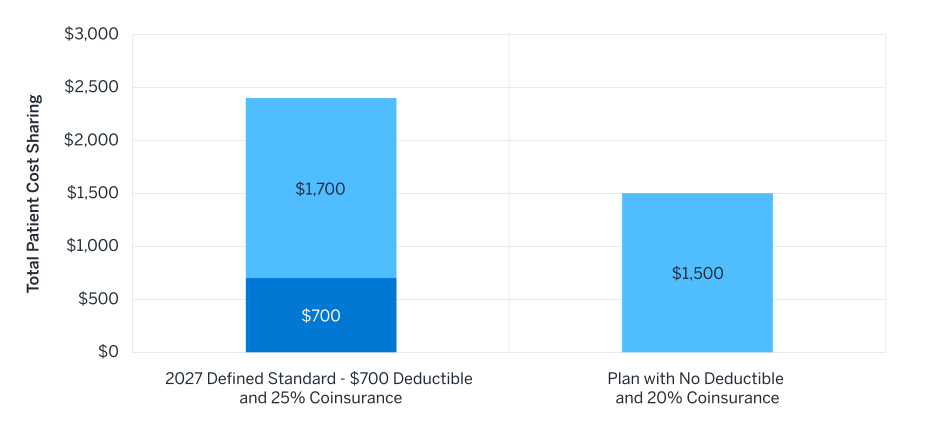
Patients who take high-cost drugs will quickly reach their MOOP and will have no additional out-of-pocket expenses for covered drugs during the plan year once the MOOP has been satisfied. Drug manufacturers need to know if expected users take other high-cost drugs or have high-cost treatments, as some products manufacturers sell could have little to no cost sharing regardless of the cost of their own drug after the MOOP has been met.
What are some key considerations for life science companies related to patient cost sharing?
Below are eight key items that affect the dynamics between patient cost-sharing and drug usage.
-
Patient access and efficacy
Before a patient has reached their MOOP, high cost sharing on drugs can deter patients from filling prescriptions or continuing therapy.3 Higher out-of-pocket expenses may lead to lower medication adherence, affecting patient outcomes.
Drugs more likely to be adopted by Medicare-eligible patients in a MAPD or PDP plan could see more limited impact on patient access due to the mandated benefit requirements. In the Individual ACA market, an individual with an income at or below a set percentage of the federal poverty limit may qualify for cost-sharing reductions. If the expected users of a life science company's drug fall into these low-income categories for a Medicare plan or a plan in the Individual ACA market, then the patient cost sharing may have less of an impact on usage, as these members qualify for reduced cost sharing.
-
Formularies and coverage tiers
Formulary placement can affect a patient's out-of-pocket costs and accessibility.
- Tiered formularies: Drugs placed on a lower formulary tier generally have lower cost sharing for the patient. Tier placement can be based on factors such as whether the drug is generic or brand-name, the availability of therapeutic alternatives, and the plan's coverage preferences.
- Prior authorization and step therapy: These utilization management tools could add hurdles beyond cost sharing. If the plan requires prior authorization for coverage or requires the member to first try an alternative drug or drugs, often on a lower tier, the manufacturer's drug may not be accessible to all patients with the drug's indications. This can increase a patient's total out-of-pocket cost if the alternative drugs do not work and they ultimately move onto the second-line therapy anyway.
- Formulary exclusions: If a patient wants to take a non-covered drug, they will either have to pay the full cost of the drug or apply to their insurance company for a formulary exception, which may have higher cost sharing than covered drugs.
-
Market access and reimbursement
Understanding a patient's cost sharing and the net liability to a health plan can help manufacturers negotiate better formulary placement. By understanding how liability is shared among the various stakeholders, manufacturers can design their rebate arrangements to make their drug more competitive. For example, if a high-cost drug offers significant rebates that lower the health plan's net liability, it may be considered for better formulary placement. Also, the differences in cost sharing by insurance type or member income level can guide manufacturers' marketing and education efforts.
These same insights help inform launch pricing and contracting strategies. Knowing what patients are expected to pay out of pocket for drugs under various insurance plans can help manufacturers set prices to ensure their product is accessible to as many patients as possible. It can also guide negotiations with pharmacy benefit managers (PBMs) for reimbursement terms such as the rebates manufacturers plan to offer.
-
In-network vs. out-of-network coverage
Some insurance plans have contracts with in-network pharmacies that provide prescriptions at lower cost to the beneficiary, influencing patient choices and access. Prescriptions filled at out-of-network pharmacies will have higher out-of-pocket costs for patients, whereas some drugs may not be covered at all, depending on the plan design.
-
Copay accumulators and maximizers
Pharmaceutical manufacturers may offer copay assistance, often in the form of copay coupons, to help beneficiaries manage the financial burden of prescription drugs. Copay accumulator and maximizer programs are benefit design strategies used by commercial insurance plans to manage how the copay assistance offered by manufacturers affects the amount a patient pays and the amount a plan pays for drugs. These programs apply the value of the copay assistance to reduce plan and/or patient liability.
- Copay accumulator programs do not allow copay assistance to count towards the patient's deductible and out-of-pocket maximum.
- Copay maximizers are similar to accumulators, but maximizers take an additional step of setting monthly cost sharing for a drug based on the copay assistance provided by the manufacturer. Often, the plan will determine the maximum available amount of copay assistance and will set monthly cost sharing for the patient so that the coupon can cover most or all of the drug cost in equal amounts throughout the year. This helps avoid a spike in cost sharing that the member would encounter under an accumulator once they hit their coupon limit.
-
Legislative and regulatory environment
Drug manufacturers should monitor policy proposals in upcoming state and federal legislation (e.g., out-of-pocket caps, copay accumulator bans) that could affect cost-sharing dynamics so the manufacturers can respond quickly and strategically. It is also key for manufacturers to understand how their drugs are classified within these proposals to determine which provisions may apply to their drugs and understand changes relative to their competitors.
-
Competitive intelligence
Drug manufacturers need to know the answer to the question: what cost-sharing do patients pay for my competitor's product or alternative therapies? Understanding the landscape is essential to help shape decisions around market positioning and pricing. Benchmarking can help manufacturers gain insight into their product's market share against competitors in the same therapeutic class, which can reveal important insights about the drivers of performance.
-
Patient assistance programs
Patient assistance programs can help patients manage medication costs, which can otherwise act as a barrier to starting and adhering to necessary therapies. Some programs are listed below:
- Manufacturer patient assistance programs are offered by pharmaceutical companies to provide medications for free or at a reduced cost to eligible individuals, typically those who are uninsured, underinsured, or on government insurance plans such as Medicare or Medicaid, but otherwise unable to afford their prescription costs.
- The Medicare Prescription Payment Plan (M3P) is an optional program for Medicare Part D beneficiaries that allows them to spread out their out-of-pocket prescription drug costs over the plan year instead of paying high costs upfront at the pharmacy.
- State Pharmaceutical Assistance Programs (SPAPs) are state-run programs that help eligible beneficiaries by subsidizing plan premiums, deductibles, and other copays.
These programs can provide drugs to patients who otherwise could not afford them, and can also provide a more stable patient experience.
Final thoughts: What the life science industry should know about patient cost sharing
Patient cost sharing is a critical factor that influences many aspects of the life science industry, including drug pricing, launch strategy, market access, and patient support. With ongoing changes in insurance plan design and a dynamic regulatory environment, life science companies must be proactive in monitoring and responding to changes to remain competitive in the marketplace and ensure patients have access to the medications they need.
1 Centers for Medicare and Medicaid Services. (2026, January 26). Advance notice of methodological changes for calendar year (CY) 2027 for Medicare Advantage (MA) capitulation rates and Part C and Part D payment policies. Retrieved June 23, 2026, from https://www.cms.gov/files/document/2027-advance-notice.pdf.
2 Karcher, J., Magnusson, J., & (Klein) Robb, M. (2024, August 27). Out of whose pocket? Many beneficiaries will spend less than expected to reach the IRA’s new $2,000 out-of-pocket spending limit. Milliman. Retrieved June 23, 2026, from https://us.milliman.com/en/insight/out-of-whose-pocket-inflation-reduction-act.
3 Reed, R. (2024, December 11). How could reducing prescription drug prices save patients money? Harvard Law Today. Retrieved June 23, 2026, from https://hls.harvard.edu/today/how-could-reducing-prescription-drug-prices-save-patients-money/.