At the age of five I was introduced to the concept of exponential growth by a television advert about the myth of the origin of chess.
The story goes that an inventor presented chess to a king, who was so impressed that he allowed the inventor to name his price for this wonderful new game. The inventor asked merely for one grain of rice on the first chess square, followed by a doubling of rice for each subsequent square. The king thought this a low price to ask and agreed there and then, considering the matter closed. It was not.
By the time the payment of rice was halfway through the chess board the king was in debt by 4,295 million grains of rice; roughly 90 tonnes of rice, which in today’s terms would equate to about £360,000. There was not enough rice in the land to fulfil this payment1 and the king had to default on his promise, i.e., have the inventor killed.
This story is not terribly surprising if you understand exponential growth (and human behavior). What is surprising is that even when we do understand the concept of exponential growth, human intuition still has a hard time recognising what this means in real world applications.
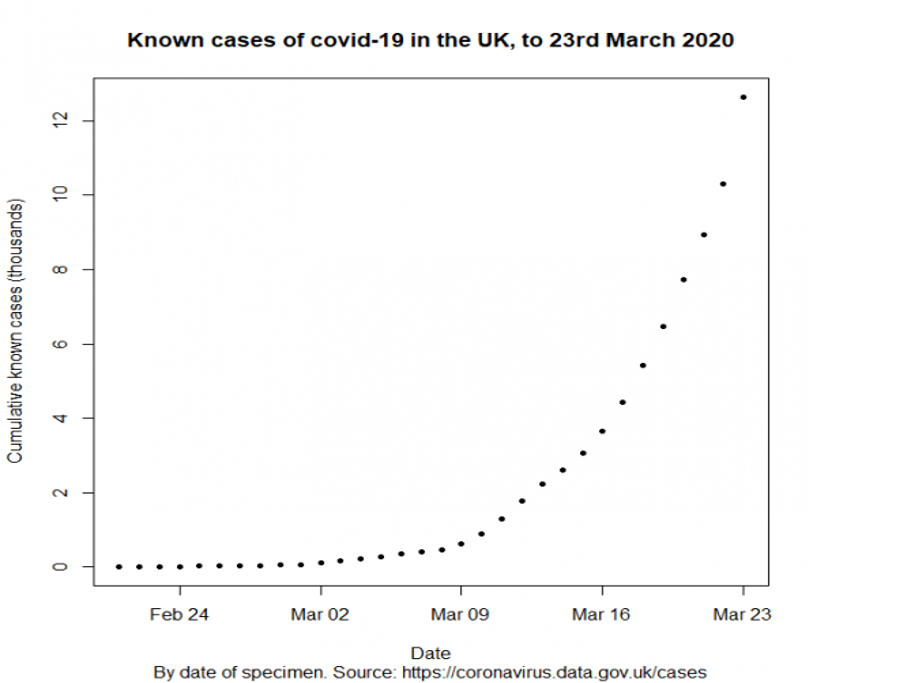
Viruses are a textbook example of exponential growth in practice, therefore consider the spread of COVID-19 in the UK. Initially numbers started low and remained low (but growing). As humans our brains are more geared to perceiving linear growth and therefore the slow growth in the early days did not seem concerning. However, by March 2020 reported cases2 were doubling every three days (see Figure 1) with around 2,000 new cases reported per day before lockdown was introduced on the 23rd of March. Because any lockdown measures have a delayed effect on numbers, cases continued to grow for the next two weeks before they started declining.
Could it be that we are underestimating a similar growth in climate factors because the impacts we are seeing now are few (but growing)?
FIGURE 1: EXPONENTIAL GROWTH OF COVID-19 CASES IN MARCH 2020 (UK GOVERNMENT, [2020])
What is surprising is that even when we do understand the concept of exponential growth, human intuition still has a hard time recognising what this means in real world applications.
Exponential growth and climate
Consider for example the number of days above 30 degrees in the UK over the past 10 years (Figure 2). This number has been increasing since 2010 and roughly doubling every consecutive three-year period. If we were to assume a linear increase in this growth, then by 2030 we could expect around 16 days over 30 degrees per year (Figure 3). Now consider exponential growth on the same numbers. Assuming the number of days per year above 30 degrees doubles every four years, this leads us to around 32 days per year in the UK above 30 degrees by 2030. Doubling every four years could be considered a conservative view of the trend given the past 10 years. Therefore, consider a doubling of these days every three years. This brings us to 64 days in the year where temperatures are above 30 degrees in the UK by 2030.
FIGURE 2: NUMBER OF DAYS PER YEAR ABOVE A GIVEN TEMPERATURE IN THE UK (METRAWEATHER, [2021])
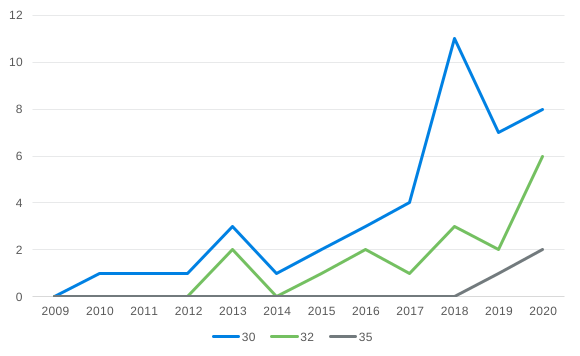
FIGURE 3: PROJECTED NUMBER OF DAYS PER YEAR OVER 30 DEGREES IN THE UK (METRAWEATHER, [2021])
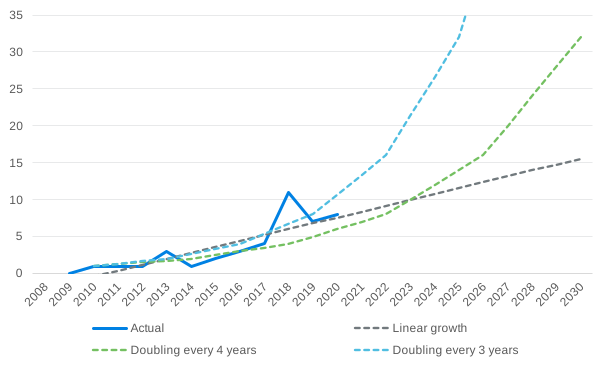
Arguably there are only around 90 days of summer (though you are forgiven for not believing this in 2021) and the number cannot increase indefinitely. However, assuming linear versus exponential growth in a stress scenario is the difference between parts of summer being stiflingly hot for UK standards and experiencing these temperatures for most of summer. To think about it in a different way; it’s the difference in outcomes between just dealing with a few hot days a year or potentially needing to implement cooling measures which enable people to go about their daily lives.3
Considering heat stress can trigger confusion, dizziness, fatigue, nausea and even death4 in extreme cases, and that everything from housing to underground services potentially need to be retrofitted to deal with high temperatures; then ignoring the possibility that increases seen in extreme weather could potentially be exponential may be detrimental to your business model and a dangerous oversight in your stress scenarios.
It is of course not only rising surface temperatures that are of concern when it comes to climate change. Similar consideration should be given to scenarios involving rising sea levels, flooding, and windstorms to name a few. Like with COVID-19, the work being done now to reduce and remove carbon emissions will have a lag before any change in atmospheric conditions are seen. Unlike COVID-19, however, efforts now could take decades before we start seeing a decline in extreme climate conditions.
Unseen exponential growth
There is another aspect at play along with potential exponential-like growth of underlying factors to be wary of in business considerations; the head start competitors are getting on those who have not yet realised that (to borrow from Andrew Bailey, the Governor of the Bank of England) “…climate change is the ultimate systemic risk.”5 This includes preparing for a very different future as well as setting net-zero emissions targets on a corporate level to mitigate transition impacts from climate change.
Stories about the downfall of companies that failed to see how fast the world was changing and fully appreciate what competitors were doing as a result are multiple. Think Blockbuster, Kodak, Blackberry, MySpace, Yahoo, Nokia… need I go on?
Several insurers and asset managers have already made public their net-zero ambitions. Not only with respect to their financing activities but across operations and supply chains as well. What remains to be seen is what actions are taken and policies implemented as a result. It may be that once this becomes known some businesses will emerge a few steps ahead.
Businesses using well thought out climate scenarios that consider interactions between physical and transition risks, as well as across supply chains and business functions, may well find themselves with a leading advantage. Particularly if these scenarios are used to develop effective risk management strategies and early warning indicators.
Are you prepared?
At Milliman we have seen an increase in the number of financial institutions approaching us to help them understand how financial risks from climate change should feed into their risk frameworks, and hence strategic plans. What generally starts as a discussion to allow for SS3/19 from UK institutions becomes a realisation of the major risks that could be experienced over the next 30 years in the run-up to achieving net zero by 2050. Some of these risks will be as a result of climate, others will be due to the actions businesses and governments will need to implement to slow down global warming. One way or another, everyone will be affected by climate change. The insurance industry in particular will be directly and immediately impacted. Are you prepared?
Further reading?
We have produced several papers on the topic of climate change.
An overview of the UK requirements under SS3/19 can be found here.
For a summary of the European Insurance and Occupational Pensions Authority (EIOPA) opinion on the supervision of the use of climate change risk scenarios in the own risk and solvency assessment (ORSA), click here.
For more guidance about how to include climate change within the ORSA, you can read our detailed paper here.
1For those interested, a full chess board populated in this manner equates to 18,5E^12 million grains of rice, which is about 387,382 million tonnes and roughly £1,500,000 billion in today's terms.
2Actual cases were likely much higher given the lack of a testing infrastructure in the early days and subsequent hospitalisations.
3Actual cases were likely much higher given the lack of a testing infrastructure in the early days and subsequent hospitalisations.
4Health and Safety Executive. Heat Stress. Retrieved 10 October 2021 from https://www.hse.gov.uk/temperature/heatstress/index.htm.
5Andrew Bailey speech: Tackling Climate for Real: The Role of Central Banks.