Executive summary
California’s Medicare Advantage program for dual-eligible beneficiaries continues to shift toward integrated Dual Eligible Special Needs Plans (D-SNPs) to deliver Medicare and Medicaid (known as Medi-Cal in California) benefits. Stemming from the Centers for Medicare and Medicaid Services (CMS) Financial Alignment Initiative and Medicare-Medicaid Plans (MMPs), since 2023, California has advanced its Medicare-Medi-Cal (Medi-Medi) Plan model, which uses D-SNPs with exclusively aligned enrollment (EAE) to coordinate Medicare and Medi-Cal benefits through affiliated plans. D-SNP enrollment has grown steadily, and most California D-SNP members are now enrolled in Medi-Medi Plans. At the same time, state restrictions on D-SNPs without EAE have played a role in market exits, reduced service areas, and a greater concentration among plans that support California’s integration strategy. This white paper discusses California D-SNP market dynamics, historical and current enrollment growth, and the default enrollment pilot program.
California D-SNP market background
The Medicare Advantage market for dual-eligible beneficiaries has grown substantially nationwide from 2021 to 2026, in both the number of D-SNPs offered and total enrollment associated with these plans.1 This growth has been shaped by CMS and state Medicaid agencies’ continued focus on integrating Medicare and Medicaid coverage. Due to Medicaid state-level policy, growth varies from state to state for D-SNPs.
In California, a major component of the California Advancing and Innovating Medi-Cal (CalAIM) initiative is the state’s transition from MMPs to EAE D-SNPs, known as Medi-Medi Plans in California. EAE occurs when a state limits D-SNP enrollment to full-benefit dual-eligible individuals who receive their Medicaid benefits from the D-SNP or an affiliated Medicaid managed care plan offered by the same parent organization as the D-SNP. This approach builds on earlier CMS and California Department of Health Care Services (DHCS) integration efforts, including the Financial Alignment Initiative and MMPs. The CalAIM EAE D-SNP initiative began in 2023 as MMPs transitioned to D-SNPs in select counties and expanded to nearly statewide in 2026. As of 2025, DHCS has frozen new enrollment in any existing non-EAE D-SNPs, while allowing existing members to remain in their current non-EAE plan if they choose.
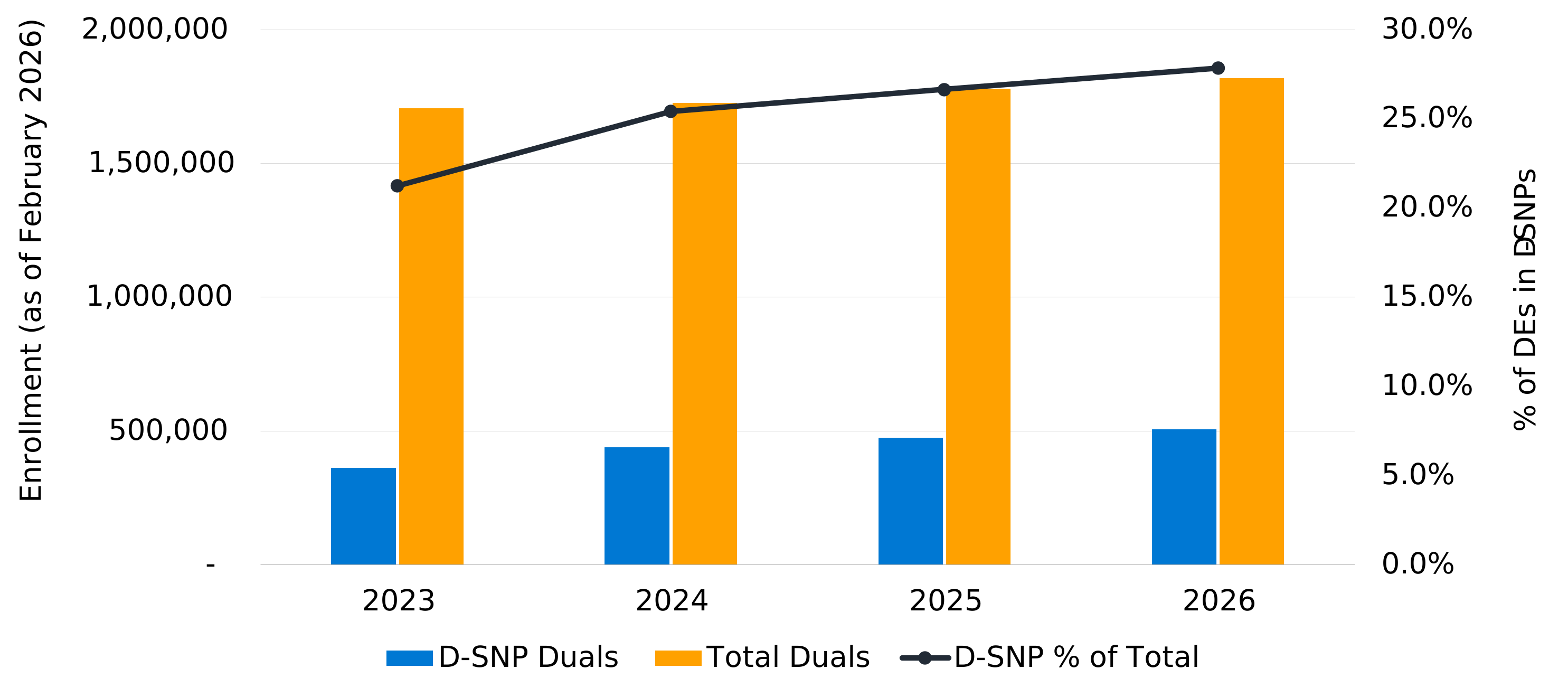
As shown in Figure 1, as of February 2026, California had approximately 1.8 million dual-eligible beneficiaries (gray bar), with approximately 500,000 enrolled in D-SNPs (green bar). This represents nearly a 28% D-SNP penetration rate (blue dot) in 2026, up from approximately 21% in 2023 when the CalAIM EAE D-SNP initiative launched. Throughout this time, D-SNP penetration rates vary significantly by county, with San Mateo, Sacramento, and San Bernardino consistently showing some of the highest penetration rates at approximately 48%, 42%, and 36%, respectively, as of February 2026. County-level details can be seen in Appendix A.
Looking forward, CMS expects the Medicare population to continue growing nationwide over the next decade as the remaining baby boomer generation ages into Medicare. Growth is expected to gradually slow as this demographic transition matures. At the same time, enrollment in private Medicare Advantage plans is projected to continue increasing on nationwide, with the share of Medicare beneficiaries enrolled in private plans rising from 51% in 2025 to 56% by 2035 and stabilizing around that level thereafter. Within the Medicare Advantage market, special needs plan (SNP) enrollment, including D-SNPs, institutional SNPs (I-SNPs), and chronic condition SNPs (C-SNPs), is projected to grow from approximately 7.6 million beneficiaries in 2025 to 10.3 million in 2035, representing average annual growth of approximately 3% nationally. Over the same period, SNPs are projected to increase from approximately 11% to 13% of total Medicare enrollment and from 21% to 23% of Medicare Advantage enrollment.2
California D-SNP enrollment trends
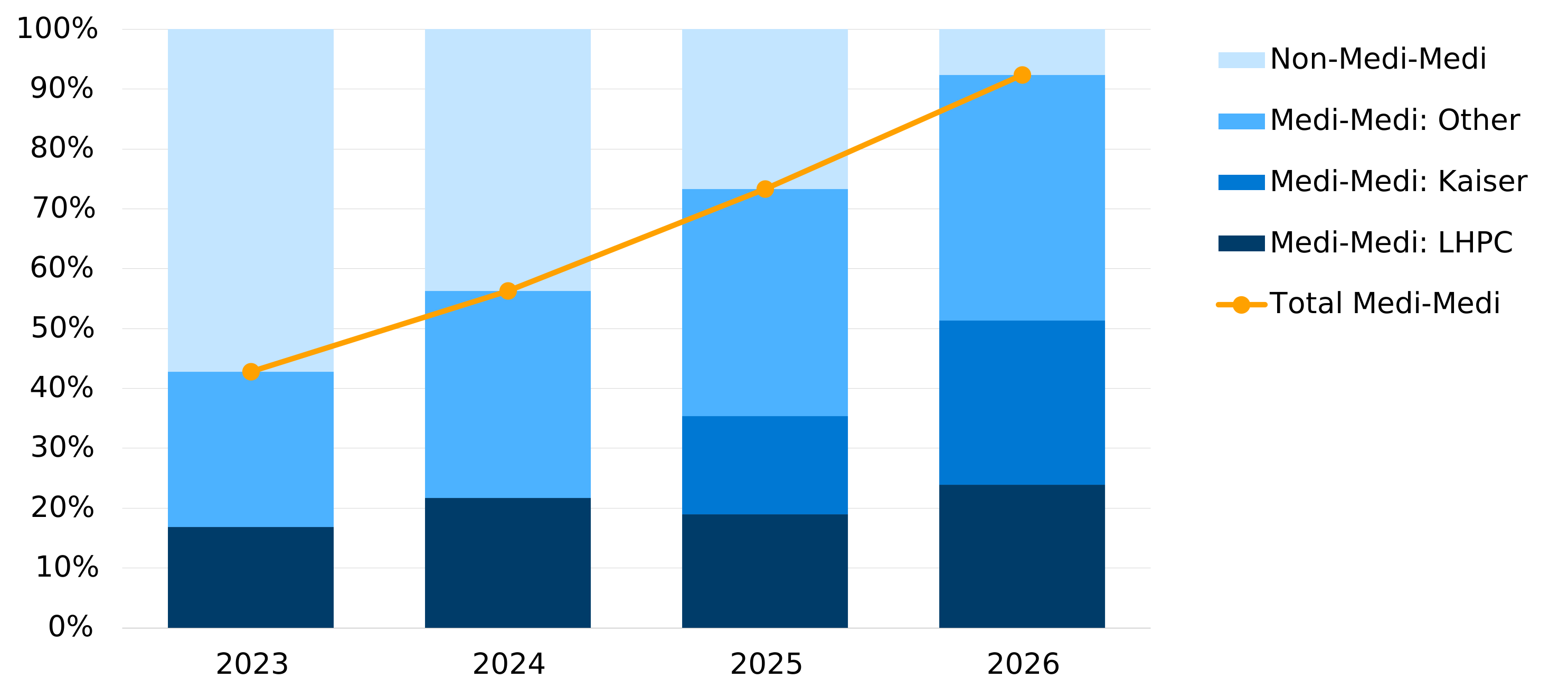
The CalAIM initiative’s impact can be seen clearly in the shift in enrollment by type of D-SNP since its launch in 2023. Based on a review of Milliman MACVAT, as shown by the red dots in Figure 2, from 2023 to 2026, the share of D-SNP members enrolled in Medi-Medi Plans increased from 43% in 2023 to 92% in 2026, leaving only roughly 8% of California’s D-SNP enrollment not in Medi-Medi Plans. Although new plans have entered the market and D-SNP enrollment has been growing overall, this increase is largely driven by existing health plans converting to or shifting their membership to Medi-Medi Plans. Figure 2 further divides enrollment by three distinct types of health plans:
- Local Health Plans of California (LHPC): LHPC is a statewide trade association that represents all 17 of the community-based, not-for-profit health plans that provide access to critical and comprehensive healthcare services for low-income populations enrolled in Medi-Cal.3 As of 2026, all LHPCs except for one offer Medi-Medi Plans. These plans account for roughly 24% of D-SNP enrollment in California.
- Kaiser Permanente: Kaiser launched its first Medi-Medi Plan in 2025, and as of 2026, all Kaiser D-SNPs in California are Medi-Medi Plans, accounting for roughly 27% of D-SNP enrollment in California. Kaiser offers a D-SNP in 30 counties in California.
- Other commercial plans: National and regional health plans also have direct state contracts or are partner plans with an LHPC to offer a Medi-Medi Plan. Medi-Medi enrollment associated with these plans has increased from roughly 26% of D-SNP enrollment in California in 2023 to approximately 41% of D-SNP enrollment in California in 2026.
Figure 2: California D-SNP enrollment distribution
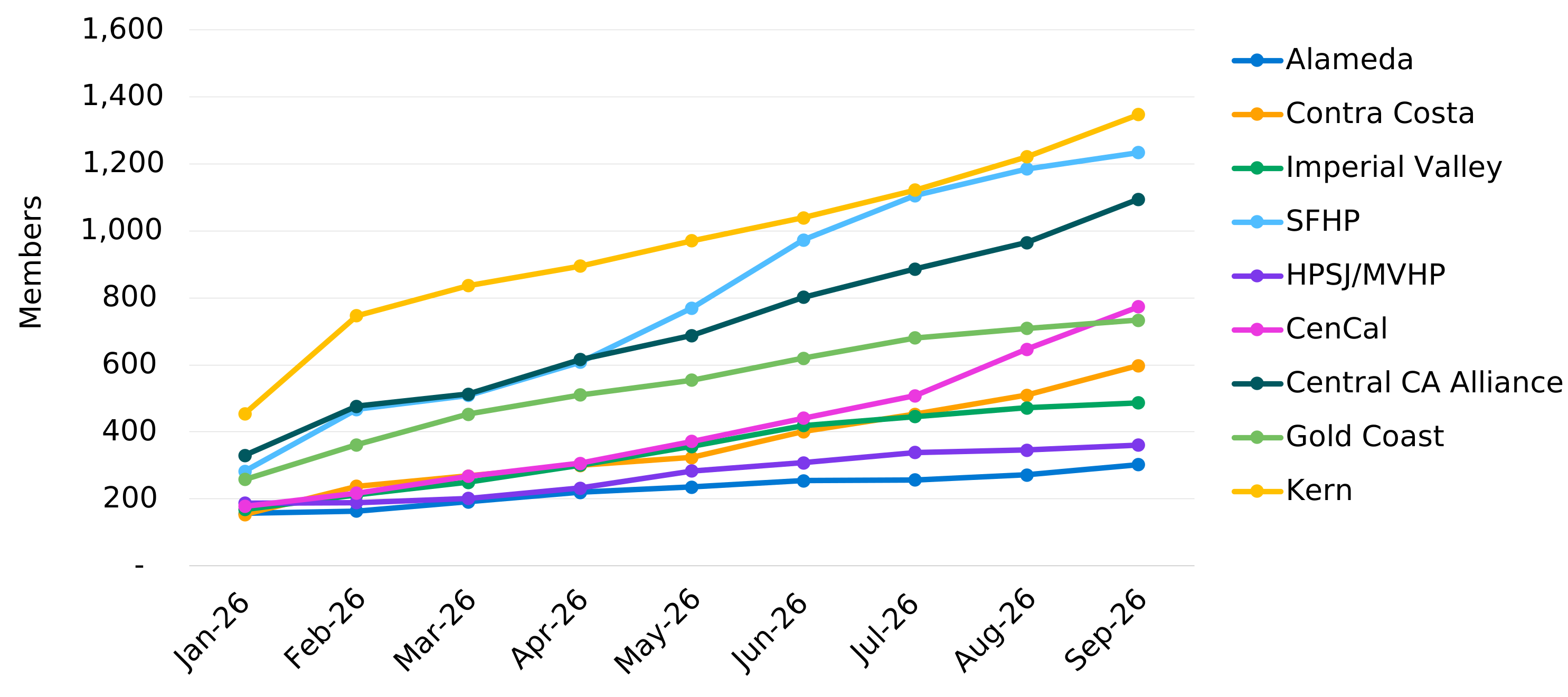
In 2026, DHCS cleared a major milestone toward the EAE D-SNP initiative when the remaining local health plans, except for Partnership HealthPlan, entered the D-SNP market. Local health plans provide Medi-Cal benefits to the majority of eligible Californians, so their participation is essential for broad alignment. Enrollment for these new plans has been small, but growth has been notable. Figure 3 summarizes enrollment growth for the nine new local health plans that entered the market in 2026.
Figure 3: Enrollment for 2026 market entrants: LHPC plans
Enrollment in closed D-SNPs (i.e., non-Medi-Medi Plans or those without associated Medi-Cal managed care plans) is expected to continue to decline without the ability to enroll new members, though nearly 40,000 members remain in these plans (or roughly 8% of California D-SNP membership) in 2026. This is down from roughly 130,000 members, or 27% of California’s D-SNP enrollment, in 2025 associated with non-Medi-Medi Plans. Several parent organizations exited or reduced their California D-SNP presence in 2026. Appendix B summarizes market entries and exits by region from 2023 to 2026.
Default enrollment in California’s Medi-Medi Plans—and what this means for enrollment growth
As part of the CalAIM integration initiative, the state is working toward implementing statewide default enrollment for the Medi-Medi Plans. Under default enrollment, when a member is enrolled in a Medi-Cal managed-care plan and becomes newly eligible for Medicare, for example, by reaching age 65, the member is automatically enrolled in the aligned Medi-Medi Plan unless they actively choose another Medicare coverage option. Default enrollment is outlined and governed by CMS, with 15 states and Puerto Rico using the default enrollment mechanism as of the end of 2025.4 Currently, select plans in California are piloting default enrollment. Starting in mid-2024, Community Health Group began the pilot program, followed by Health Plan of San Mateo in early 2025, and then by Kaiser Permanente in San Mateo County (North P2 Plan) in mid-2025.
Figure 4 shows monthly enrollment growth before and after the default enrollment pilot program for the two participating local health plans. Both saw increases in average monthly enrollment after the pilot program was implemented.
Figure 4: Default enrollment pilot program average monthly enrollment growth
| Health Plan | Pilot Start Date | Before Pilot Start Date | After Pilot Start Date |
|---|---|---|---|
| Community Health Group | 7/1/2024 | 24 | 121 |
| Health Plan of San Mateo | 1/1/2025 | -21 | 14 |
The state intends to implement default enrollment more widely. Recent public statements by DHCS indicate that it views the pilot program as a success with limited operational issues or member disruption.5 Exact details on when larger program implementation will occur have not been released. Likewise, details on participation requirements are unknown. However, DHCS has indicated that network overlap between Medi-Cal and Medicare and Medicare plan quality, as determined by Star Ratings, will be factors in approval at the plan level.
What lies ahead for California’s dual-eligible Medicare Advantage market?
California’s dual-eligible Medicare Advantage market is increasingly centered on Medi-Medi Plans and aligned Medicare and Medi-Cal D-SNPs. State policy, federal integration priorities, and restrictions on non-aligned D-SNPs are accelerating this shift. As a result, enrollment growth is concentrated among aligned plans, while enrollment in closed and non-aligned D-SNPs continues to decline. Default enrollment may further increase Medi-Medi Plan enrollment, particularly among newly Medicare-eligible Medi-Cal members. Overall, California’s market is likely to continue moving toward greater integration, with plan participation and enrollment patterns shaped by both state and federal policy changes. Looking ahead, enrollment growth, the default enrollment pilot, and the growth of competing C-SNPs will continue to shape the market.
Download article with appendices1 Johnson, N., Hallum, A., Gipe, N., & Blank, L. (2026, April). Key insights into 2026 Medicare Advantage D-SNP landscape. Milliman. Retrieved October 15, 2026, from https://media.milliman.com/v1/media/edge/images/millimaninc5660-milliman6442-prod27d5-0001/media/Milliman/PDFs/2026-Articles/4-8-26_Key-insights-into-2026-Medicare.pdf.
2 The Boards of Trustees, Federal Hospital Insurance and Federal Supplementary Medical Insurance Trust Funds. (2026, June 9). 2026 Annual report of the Boards of trustees of the Federal Hospital Insurance and Federal Supplementary Medical Insurance trust funds. Centers for Medicare and Medicaid Services. Retrieved October 15, 2026, from https://www.cms.gov/oact/tr/2026.
3 About local plans [Fact sheet]. (n.d.). Local Health Plans of California. Retrieved October 15, 2026, from https://www.lhpc.org/sites/main/files/fact_sheet-lhpc_about_us_01.2026.pdf.
4 Default enrollment: Policy and data on approved Medicare Advantage plans. (2026, April 7). Centers for Medicare and Medicaid Services. Retrieved October 15, 2026, from https://www.cms.gov/files/document/chart-approved-ma-organization-default-enrollment-4q2025.pdf.
5 See the bottom of page 22 at CalAIM managed long term services and support duals integration. (2026, August 26). California Department of Health Care Services. Retrieved October 15, 2026, from https://www.dhcs.ca.gov/wp-content/uploads/2026/09/August-26-MLTSS-and-Duals-Integration-Workgroup-Meeting-Transcript-1.pdf.