The Transforming Episode Accountability Model (TEAM) is a mandatory, episode-based alternative payment model established by the Centers for Medicare and Medicaid Services (CMS) that aims to improve quality of care and reduce Medicare spending for five surgical procedures. The five-year model began on January 1, 2026, and applies to acute care hospitals paid under the Inpatient Prospective Payment System (IPPS) and Outpatient Prospective Payment System (OPPS) in selected core-based statistical areas (CBSAs).
Under TEAM, hospitals are held financially accountable for the total cost of care for Medicare fee-for-service (FFS) beneficiaries who undergo five high-volume, high-cost surgical procedures with documented variation in spending:
- Lower extremity joint replacement (LEJR)
- Surgical hip/femur fracture treatment (SHFFT)
- Coronary artery bypass graft (CABG)
- Spinal fusion (FUSION)
- Major bowel procedures (BOWEL)
Each episode includes the anchor hospitalization that initiated it and a 30-day post-acute period, which starts on the first day of the anchor discharge for episodes initiated in an inpatient setting or the day of the outpatient procedure for episodes initiated in an outpatient setting. Financial reconciliation occurs retrospectively, with hospitals potentially earning a reconciliation payment or owing repayment to CMS, depending on their performance relative to a pre-established target price and their quality performance.
In case you missed it:
Target prices are a foundational element of TEAM because they define the financial benchmark against which episode spending is assessed. For each hospital and procedure, CMS establishes a target price that represents the expected, risk-adjusted spending for an episode during the performance period. Actual episode spending is compared to this benchmark to determine savings or losses, subject to quality adjustments and other model provisions.
For hospitals participating in TEAM, understanding how target prices are constructed is important. Target prices influence not only reconciliation outcomes but also internal budgeting, forecasting, physician alignment strategies, and care redesign efforts. Because the target price incorporates multiple components—such as historical spending, risk adjustment, trend, regional benchmarking, and model-level scaling—it is not always intuitive how CMS derives the final figure. This paper focuses on unpacking those calculations to help TEAM participants better interpret and understand their target prices.
TEAM was finalized in the fiscal year (FY) 2025 Hospital IPPS final rule (CMS-1808-F)1 and revised in the FY 2026 IPPS final rule (CMS-1833-F).2 All information contained here describing TEAM is drawn from these final rules, which were released on August 1, 2024 and August 4, 2025, respectively, as well as the TEAM Clinical Episode Construction Specifications3 and the TEAM Risk Adjustment and Preliminary Target Price Specifications.4
Clinical episode construction under TEAM
In TEAM, a clinical episode includes most services associated with a defined surgical procedure from the anchor hospitalization or procedure through 30 days of post-acute care.
Triggering events
Episodes are initiated (or “triggered”) by specific inpatient or outpatient procedures, identified by Medicare Severity Diagnosis Related Group (MS-DRG) or Healthcare Common Procedure Coding System (HCPCS) codes, respectively. For example, an LEJR episode is triggered by a relevant MS-DRG code (i.e., 469, 470, 521, or 522) or HCPCS code (i.e., 27447, 27130, or 27702) for hip, knee, or ankle replacement surgery. CMS updates code mappings periodically to account for changes in classification, and historical episodes are remapped forward to the performance year (PY) when necessary for consistency between baseline and performance period calculations.
Exclusions and standardization
Not all services associated with a patient’s care during the episode window are included. CMS excludes unrelated claims, such as high-cost Part B drugs, hemophilia clotting factors, and hospitalizations for oncology, trauma, and organ transplantation. Other claims—such as new technology add-ons, pass-through payments for medical devices on outpatient claims, and claims initiated in the state of Maryland—are also excluded. Payments for all non-excluded services are standardized to remove geographic or hospital-specific adjustments, allowing comparison of spending across hospitals and regions.
Baseline periods and PY alignment
For each TEAM PY, CMS establishes a three-year baseline period consisting of historical clinical episodes. The baseline period rolls forward for each PY so that the most recent data is incorporated into the target price.
Figure 1: Alignment of PYs and baseline periods
| Performance year (PY) | PY start–end | Baseline period start–end |
|---|---|---|
| PY 1 | 1/1/2026 to 12/31/2026 | 1/1/2022 to 12/31/2024 |
| PY 2 | 1/1/2027 to 12/31/2027 | 1/1/2023 to 12/31/2025 |
| PY 3 | 1/1/2028 to 12/31/2028 | 1/1/2024 to 12/31/2026 |
| PY 4 | 1/1/2029 to 12/31/2029 | 1/1/2025 to 12/31/2027 |
| PY 5 | 1/1/2030 to 12/31/2030 | 1/1/2026 to 12/31/2028 |
Source: Center for Medicare and Medicaid Innovation. (2025, September). Transforming episode accountability model (TEAM) Clinical episode specifications. Centers for Medicare and Medicaid Services.
Baseline periods and PY 1 include clinical episodes with anchor start dates on or after the period start date and anchor end dates on or before the period end date. PYs 2–5 include clinical episodes with anchor end dates in the applicable calendar year.
Scaling prices
Standardized episode spending for facility services during the anchor hospitalization or procedure for clinical episodes in the baseline period is adjusted to PY dollars using scaling factors. These factors are based on the MS-DRG associated with the initiating inpatient stay for the episode or the HCPCS code for the initiating outpatient procedures. The scaling factor accounts for changes to payment rates and any updates to code mapping.
The scaling factor is calculated as the change in the relative weight for the initiating service between the baseline period and the PY. For inpatient stays, the MS-DRG relative weight is used; for outpatient procedures, the Ambulatory Payment Classification (APC) weight is used.5
The portion of the episode spending associated with the anchor stay or procedure (excluding add-on or outlier payments) is adjusted by this scaling factor, inflating payments to reflect PY fee schedules.
Winsorization
To reduce the impact of extreme outliers, CMS winsorizes—a statistical technique that caps values at a specified percentile rather than removing them—clinical episode spending at the 99th percentile for each MS-DRG/HCPCS episode type (with outpatient HCPCS episodes grouped into their associated inpatient MS-DRG type),6 region,7 and calendar year. Episode spending that exceeds the 99th percentile is capped at the 99th percentile value, mitigating the impact of extreme outliers on average episode spending.
How CMS calculates a benchmark price
Once clinical episodes are constructed and spending is standardized, scaled, and winsorized, CMS calculates a benchmark price for each MS-DRG/HCPCS episode type and region. The benchmark price represents the expected spending for a typical episode and is the basis for hospital-specific target prices.
FAQ: Does the TEAM benchmark reflect a hospital's own historical spending or regional experience?
TEAM target prices are based on Medicare FFS episode spending across all hospitals in the hospital's geographic region during the baseline period, not the individual hospital's own spending history. This means every participating hospital in a region starts from the same benchmark, regardless of its historical spending levels.
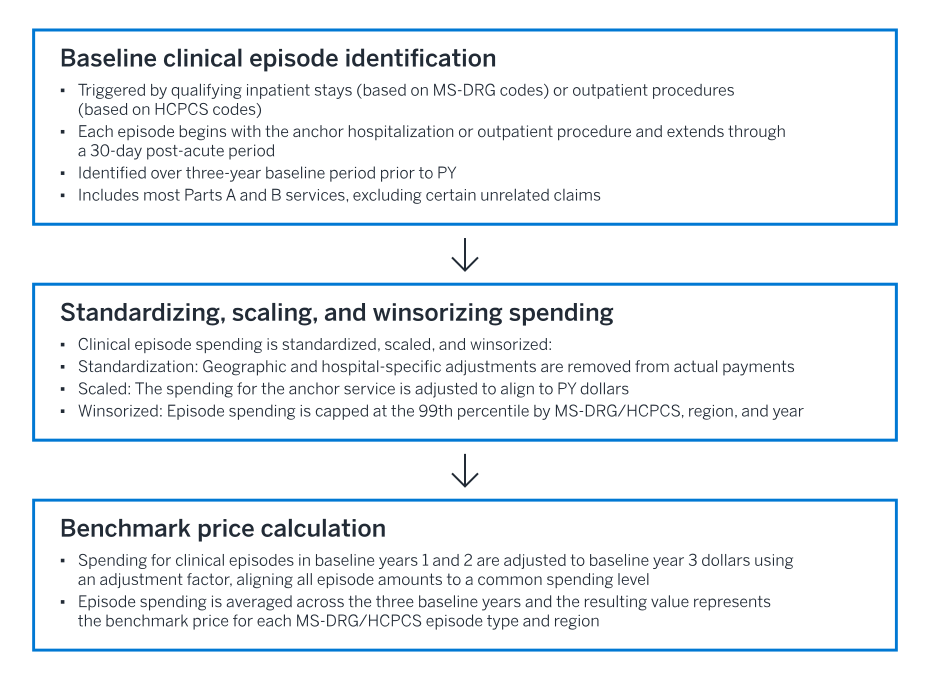
Figure 2 illustrates the process to calculate the benchmark price from the baseline clinical episodes, described in the following sections.
Figure 2: Process for calculating the benchmark price from the baseline clinical episodes
Adjusting baseline spending
Clinical episodes are first grouped by baseline year based on their anchor end date. To ensure comparability across years, CMS applies an adjustment factor that aligns all baseline episode amounts to the spending level of the most recent baseline year.
For each MS-DRG/HCPCS episode type and region, the adjustment factor for a given baseline year is calculated as the ratio of the average standardized, scaled, and winsorized episode spending in the most recent baseline year to the corresponding average in that baseline year. Figure 3 illustrates this adjustment.
Figure 3: Illustrative example of baseline year adjustment factors and adjusted episode spending
| Label | Illustrative value | Formula | |
|---|---|---|---|
| [1] | Average Episode Spending* for MS-DRG/HCPCS Episode Type 469 in Census Division 1 (Baseline Year 1) | $20,000 | |
| [2] | Average Episode Spending* for MS-DRG/HCPCS Episode Type 469 in Census Division 1 (Baseline Year 3) | $25,000 | |
| [3] | Adjustment Factor for MS-DRG/HCPCS Episode Type 469 in Census Division 1 | 1.25 | = [2] / [1] |
| [4] | Episode Spending* for Sample Episode with MS-DRG/HCPCS Episode Type 469 in Census Division 1 (Baseline Year 1) | $18,000 | |
| [5] | Adjusted Episode Spending* for Sample Episode in Baseline Year 3 Dollars | $22,500 | = [3] x [4] |
* Reflects standardized, scaled, and winsorized spending.
Source: Center for Medicare and Medicaid Innovation. (2025, September). Transforming Episode Accountability Model (TEAM) Risk adjustment and preliminary target price specifications. Centers for Medicare and Medicaid Services.
This adjustment forces the average episode spending in each baseline year to equal the average spending in the most recent baseline year, effectively anchoring the benchmark to spending levels for the most recent baseline year (i.e., baseline year 3).
Aggregating to the benchmark price
After baseline episode spending has been adjusted to the most recent baseline year’s dollars, CMS calculates the benchmark price by aggregating adjusted episode spending across the three baseline years. Although the FY2025/FY2026 IPPS Final Rule specifies differential baseline year weights—17% for the oldest baseline year, 33% for the second most recent year, and 50% for the most recent year—the weighting step is algebraically redundant.
Because the adjustment factors align average episode spending between each baseline year and the most recent baseline year, applying equal or differential weights yields the same benchmark price. As a result, the benchmark price is effectively anchored to the average standardized, scaled, and winsorized episode spending in the most recent baseline year, as earlier baseline years do not impact the benchmark itself.
FAQ: Why does baseline year weighting not affect the benchmark price in TEAM?
In TEAM, baseline year episode amounts from the first two baseline years are adjusted to the spending level of the most recent baseline year using adjustment factors derived from baseline year averages, effectively aligning the average episode spending across all baseline years to the same value. As a result, applying either equal or differential weights when averaging the spending across baseline years produces the same benchmark price. Therefore, baseline year weighting is algebraically redundant and does not influence the benchmark level.
Risk adjustment for patient and hospital characteristics under TEAM
Risk adjustment in TEAM accounts for differences in patient and hospital characteristics that impact episode spending, ensuring that hospitals are evaluated fairly. By adjusting for clinical complexity, comorbidities, demographics, and hospital-level factors, the model isolates spending differences in patient acuity and case mix from differences in care delivery patterns, resource use, and efficiency.
Risk adjustment variables
The TEAM model incorporates both patient-level and hospital-level variables. Figure 4 outlines the patient-level risk adjustment variables.
Figure 4: Patient-level risk adjustment variables
| Patient-level variable | Specifications | Notes |
|---|---|---|
| Hierarchical Condition Category (HCC) | Flags for HCCs are identified using Version 28 of the CMS Medicare Advantage Risk Adjustment software in the 180-day period prior to the episode. | The HCCs used differ for each episode type. |
| HCC count | Count of HCCs for a given beneficiary in the 180-day period prior to the episode. | Categorized into five variables: 0, 1, 2, 3, or 4+ HCCs. |
| Post-acute care | Indicates whether the beneficiary had any post-acute care (i.e., long-term acute care, skilled nursing facility care, home health, or inpatient rehabilitation facility care) stay in the 180-day period prior to the episode. | Applicable to CABG, LEJR, and FUSION episode types only. |
| Age group | Age of a given beneficiary. | Categorized into four variables: under 65, 65–74 years old, 75–84, and 85+. |
| Disability | Indicates whether disability was the original reason for Medicare entitlement. | Applicable to LEJR episode type only. |
| Long-term institutional (LTI) care | Indicates whether the beneficiary was institutionalized in a long-term care facility in the 180 days prior to the episode. | Applicable to BOWEL episode type only. |
| LEJR-specific adjustments | Indicates whether the beneficiary had any of the following procedures during the anchor hospitalization or procedure: • Ankle procedure or reattachment • Partial hip procedure • Total hip arthroplasty or hip resurfacing procedure • Partial knee arthroplasty • Total knee arthroplasty |
Applicable to LEJR episode type only. Five mutually exclusive risk-adjustment variables are considered for each procedure. |
| Beneficiary economic | Indicates whether the beneficiary meets at least one of the following criteria: • Resides in a census block group above the 80th percentile of Community Deprivation Index (CDI) • Eligible for Part D low-income subsidy copayment (LIS) • Fully eligible for Medicare and Medicaid (i.e., dual eligible) |
The model coefficient for this variable is only used if its sign is positive. CMS applies this condition to ensure the risk adjustment does not inadvertently reduce target prices for hospitals that disproportionately serve economically disadvantaged populations. |
Source: Center for Medicare and Medicaid Innovation. (2025, September). Transforming Episode Accountability Model (TEAM) Risk adjustment and preliminary target price specifications. Centers for Medicare and Medicaid Services.
FAQ: What is the Community Deprivation Index (CDI)?
- CDI is a composite measure of socioeconomic deprivation calculated at the census block group level
- It incorporates 18 variables – including income, education, unemployment, home value, and insurance status – to develop a score that can be used in health equity research
- CDI builds on the Area Deprivation Index (ADI), which has been used in other CMS models such as the ACO REACH program
- Unlike ADI, which is heavily influenced by home value and may not accurately reflect deprivation in urban areas, CDI standardizes input variables so no single factor, such as home value, disproportionately affects the score
- Milliman analysis indicates that shifting from ADI to CDI can result in material changes in the calculated 80th percentile, which impacts risk adjustment under TEAM
Figure 5 outlines the hospital-level risk adjustment variables.
Figure 5: Hospital-level risk adjustment variables
| Hospital-level variable | Specifications | Notes |
|---|---|---|
| Safety-net hospital | Indicates whether the hospital is a safety net hospital. | For purposes of TEAM, a safety net hospital is defined as an IPPS hospital* that exceeds the 75th percentile for either the proportion of Medicare beneficiaries dually eligible for Medicare and Medicaid, or the proportion partially or fully eligible for Medicare Part D LIS. |
| Bed size | Hospitals are grouped by bed size. | Categorized into four variables: small (0–250 beds), medium (251–500), large (501–850), and extra-large (851+). |
* Excluding certain specialty and demonstration hospitals.
Source: Center for Medicare and Medicaid Innovation. (2025, September). Transforming Episode Accountability Model (TEAM) Risk adjustment and preliminary target price specifications. Centers for Medicare and Medicaid Services.
To estimate the impact of these risk factors, CMS fits a weighted linear regression model separately for each MS-DRG/HCPCS episode type using national baseline episode data. The regression quantifies the relationship between the patient- and hospital-level risk characteristics and the difference between an episode’s standardized, scaled, winsorized spending and the corresponding benchmark price.
Prospective normalization factor
For each clinical episode in baseline year 3, CMS derives a risk adjustment multiplier from the regression model to reflect the expected impact of patient- and hospital-level risk factors on episode spending.
Then, CMS calculates a prospective normalization factor at the MS-DRG/HCPCS episode type and region level so that, in aggregate, applying the risk adjustment multipliers does not change total expected spending relative to the benchmark. This factor ensures that risk adjustment redistributes expected spending across episodes without increasing or decreasing the overall benchmark price.
FAQ: What’s the role of the prospective normalization factor?
- Risk adjustment changes expected episode spending based on patient complexity and hospital characteristics, which can increase or decrease a hospital’s target price
- The prospective normalization factor rescales risk-adjusted targets so that, across all hospitals for a given episode type and region, total benchmark spending stays the same
- This adjustment is budget neutral in aggregate, but results in increases or decreases to the target price at the individual hospital level
The prospective trend factor in CMS’s TEAM model
The prospective trend factor adjusts historical episode spending to reflect expected spending growth between the baseline period and the applicable PY. In the TEAM model, this factor accounts for both regional and national spending trends and is applied prospectively to the benchmark price during target price development.
The prospective trend factor incorporates five years of episode data—the three baseline years and the two calendar years immediately preceding the baseline period—unlike other components, such as the benchmark price, which rely only on the three-year baseline period. Using a longer lookback allows CMS to estimate underlying spending growth patterns rather than relying only on recent baseline experience.
For each MS-DRG/HCPCS episode type, CMS estimates two-year spending trends separately at the regional and national levels using a log-linear regression model applied to standardized, scaled, and winsorized episode spending over the five-year lookback. The final prospective trend factor is calculated as the simple average of the regional and national two-year trend factors for each MS-DRG/HCPCS episode type, blending regional spending dynamics with national spending trends and mitigating volatility from relying solely on regional experience.
FAQ: Does the prospective trend factor “double count” with price scaling or payment standardization?
No, each adjustment serves a distinct and independent purpose in the target price development:
- Payment standardization removes the impact of geographic and hospital-specific payment adjustments (e.g., IME/DSH) so that episode spending is comparable
- Price scaling adjusts the spending for the anchor hospitalization or procedure portion of the episode to reflect performance year fee schedules
- Prospective trend estimates underlying growth in episode spending (after standardizing, scaling, and winsorizing spending) over time, capturing changes that are not explained by fee schedule updates alone
Target price development under TEAM
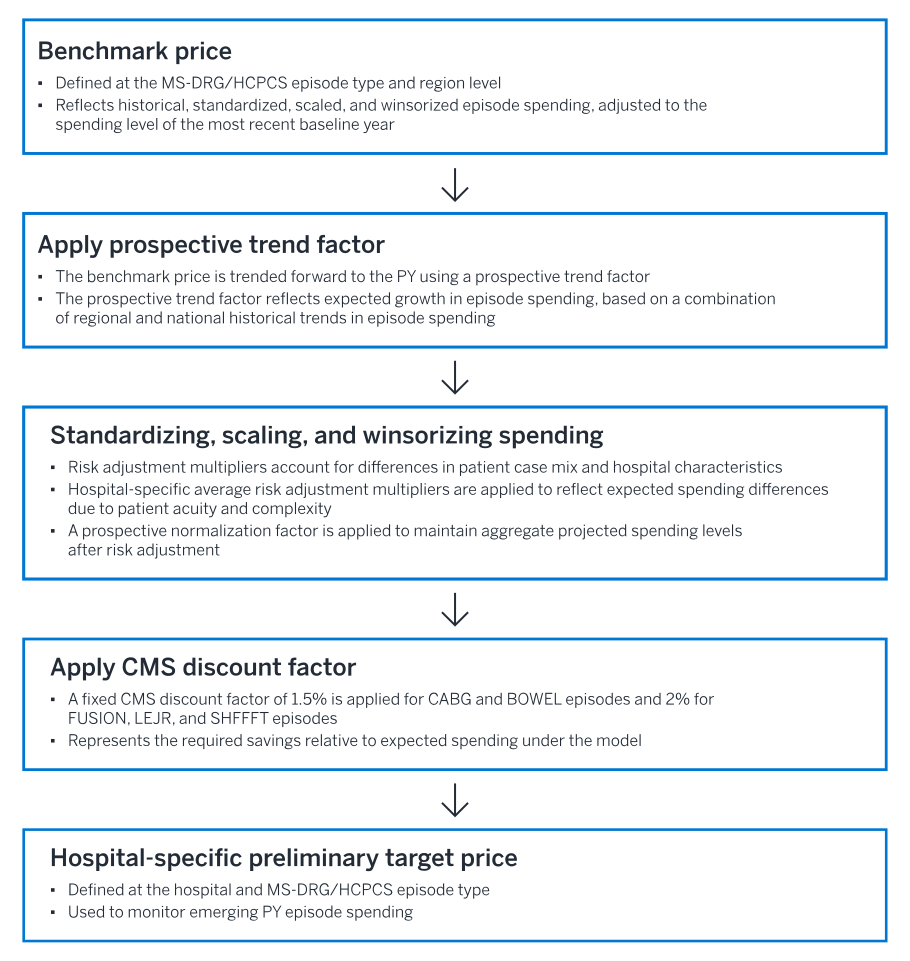
The TEAM target price combines historical episode spending, trend adjustments, risk adjustment, and a CMS-defined discount. CMS establishes preliminary target prices prospectively before the start of each PY at the MS-DRG/HCPCS episode type/region level and the hospital-specific level:
- MS-DRG/HCPCS Episode type-/region-level: The preliminary target price is calculated by applying the prospective trend factor to the benchmark price and then reducing the result by the applicable CMS discount factor.8
- Hospital-specific level: Hospital-specific preliminary target prices are derived by adjusting the MS-DRG/HCPCS episode type/region target price using the hospital’s average risk adjustment multiplier (calculated across all of the hospital’s baseline episodes for the MS-DRG/HCPCS episode type) and the prospective normalization factor. These adjustments calibrate the target price to reflect the hospital’s historical patient and case mix while preserving budget neutrality.
Figure 6 illustrates the prospective calculation of the hospital-specific preliminary target price, which is completed prior to the PY and used for monitoring emerging performance.
Figure 6: Prospective calculation of the hospital-specific preliminary target price
Preliminary vs. final target prices
Preliminary target prices are prospective and used for performance tracking during the PY. They rely on estimated trends and risk adjustment derived from baseline data and do not incorporate actual PY experience.
Final target prices are calculated after the PY ends and are used to determine actual financial reconciliation amounts. The final target price incorporates a final normalization factor and a retrospective trend factor, which recalibrate the target using finalized data and observed spending trends. To limit volatility between the prospective and final calculations, CMS caps changes to these factors: the final normalization factor must remain within ±5% of the prospective normalization factor, and the retrospective trend factor must remain within ±3% of the prospective trend factor.
FAQ: Why are target prices referred to as “preliminary”?
- Certain components of the target price calculation cannot be finalized until performance year data is available
- Preliminary target prices rely on prospective assumptions, which are replaced with retrospective assumptions in the final target price, reflecting observed experience
Closing thoughts: Understanding TEAM target prices for hospitals
A clear understanding of how TEAM target prices are constructed is important for hospitals seeking to manage performance proactively rather than reactively. Each component of the target price—from episode construction and benchmarking to trend, scaling, and risk adjustment—directly influences financial outcomes under the model. Insights into these mechanics allow organizations to identify opportunities for improvement.
With these insights, hospitals can continue to strengthen their TEAM readiness. Key priorities might include identifying high-cost post-acute utilization patterns that disproportionately drive episode spending, modeling prospective reconciliation payments, and estimating the impact of risk adjustment, such as chronic condition coding completeness.
Partnering with data, clinical, and actuarial experts can strengthen a hospital’s TEAM strategy. Hospitals that invest early in understanding and operationalizing the target price framework will be better positioned to succeed under TEAM. Milliman has extensive subject-matter expertise and data-driven tools for TEAM and other episode-based programs to highlight your organization’s areas for quality improvements and cost savings. For more information, contact your Milliman consultant.
1 See the full text of the final rule, 89 FR 68986, at https://www.federalregister.gov/documents/2024/08/28/2024-17021/medicare-and-medicaid-programs-and-the-childrens-health-insurance-program-hospital-inpatient.
2 See the full text of the final rule, 90 FR 36536, at https://www.federalregister.gov/documents/2025/08/04/2025-14681/medicare-program-hospital-inpatient-prospective-payment-systems-for-acute-care-hospitals-ipps-and.
3 Center for Medicare and Medicaid Innovation. (2025, September). Transforming episode accountability model (TEAM) Clinical episode specifications. Centers for Medicare and Medicaid Services. Retrieved December 24, 2025 from https://www.cms.gov/files/document/team-cdi-ep-constr-specs.pdf.
4 Center for Medicare and Medicaid Innovation. (2025, September). Transforming Episode Accountability Model (TEAM) Risk adjustment and preliminary target price specifications. Centers for Medicare and Medicaid Services. Retrieved December 24, 2025 from https://www.cms.gov/files/document/team-risk-adj-prelim-target-specs.pdf.
5 The initiating HCPCS code is mapped to an APC in the baseline and performance year.
6 For outpatient clinical episodes, the initiating HCPCS code is mapped to an associated MS-DRG episode type (e.g., outpatient LEJR episodes triggered under HCPCS 27447 or 27130 are grouped with inpatient LEJR episodes triggered under MS-DRG 470).
7 Regions are defined by U.S. Census Divisions.
8 The CMS discount factor is 1.5% for CABG and BOWEL episodes, and 2% for SHFFT, LEJR, and FUSION episodes.