Executive summary: How ACO benchmarks would change under LEAD
The newest total cost of care model from the Centers for Medicare and Medicaid Innovation (CMMI) is the Long-term Enhanced ACO Design (LEAD). Accountable care organizations (ACOs) interested in participating have until May 17, 2026, to apply.
Using the 2024 Medicare Shared Savings Program (MSSP) public use file (PUF), we evaluated how ACOs’ benchmarks would change under a simulated LEAD methodology. The simulation is highly simplified and assumes a global risk track, but incorporates the following key LEAD benchmark design elements:
- Benchmark discount
- Administrative add-on adjustment for regionally inefficient ACOs
- Regional efficiency adjustment/prior savings adjustment
- Benchmark adjustment cap
Across the cohort of ACOs that participated in MSSP in performance year (PY) 2024, the total benchmark decreases by approximately $3.2 billion (or 2.3%) under the LEAD framework. However, this aggregate reduction is not evenly distributed. The 395 regionally efficient ACOs1 drive the decrease in the simulated LEAD benchmark, while the 81 regionally inefficient ACOs show an approximate $70 million increase in the benchmark overall.
Figure 1: Total PY2024 benchmark per ACO ($M)
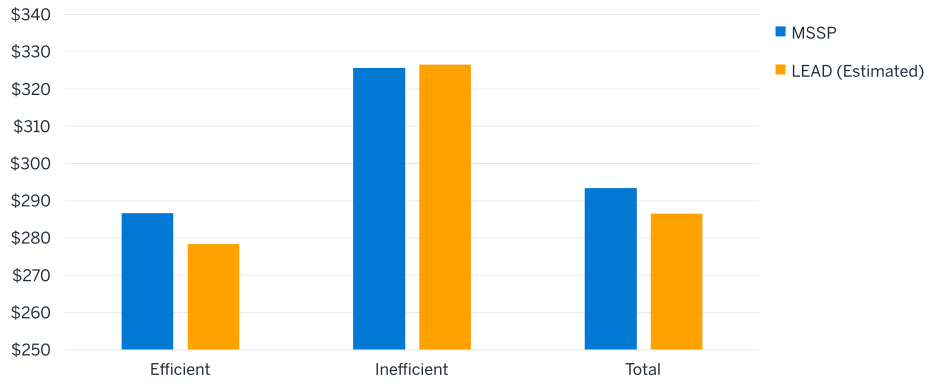
These findings suggest that regionally inefficient and historical ACOs could gain from LEAD participation due to a more favorable benchmark position (e.g., negative regional adjustment floor of 0% in LEAD). However, ACOs will also need to evaluate LEAD in the context of their specific circumstances, including the multiyear impacts of the increasing discount for inefficient ACOs and the fixed baseline over LEAD’s 10-year performance period. While we expect regional efficiency to generally correlate in MSSP and LEAD in many cases, differences between the two programs (e.g., the new high-needs cohort in LEAD) may cause regional efficiency to vary widely between the two programs in certain cases.
Background and approach: Assessing LEAD’s impact on MSSP benchmarks
The LEAD model introduces several structural changes to benchmark construction relative to MSSP. While MSSP benchmarks are built on a blend of historical expenditures and regional spending, LEAD places greater emphasis on long-term benchmark stability, coupled with explicit adjustments to address prior performance and regional efficiency.
To assess the impact, we replicated MSSP benchmarks using the 2024 PUF and then applied a simplified LEAD methodology, incorporating the items in Figure 2.
Figure 2: Lead methodology components
| LEAD methodology component | Efficient ACOs | Inefficient ACOs |
|---|---|---|
| Benchmark discount | 3.00% | 1.75% |
| Administrative add-on | 0% | 1.5% |
| Regional efficiency adjustment* | 50% blend with region | ACO experience only |
| Prior savings adjustment2 | For ACOs previously in ACO REACH or MSSP, 50% of most recent shared savings | |
The analysis is intended to isolate overall directional impacts rather than precisely replicate LEAD benchmark calculations. The analysis does not incorporate many of LEAD’s financial methodology details and considerations, like risk score model and all trend calculations. Individual ACOs will want to understand the impact of the full LEAD benchmark methodology and financial calculations on their patient panel.
Key findings: LEAD’s impact on benchmarks, regionally inefficient ACOs, and more
1. Aggregate benchmark reduction: Total benchmarks across MSSP ACOs decline by approximately $3.2 billion (approximately $7 million per ACO) under the LEAD framework. This reduction is primarily driven by the LEAD discount of 3% for regionally efficient ACOs.
Figure 3: Approximate estimate of MSSP to lead benchmark change ($m)
| Regional Efficiency | ACOs | PYs | MSSP Benchmark |
LEAD Benchmark |
Benchmark Change |
% Change |
|---|---|---|---|---|---|---|
| Efficient | 395 | 8,448,951 | $113,254.6 | $109,947.5 | -$3,307.2 | -2.9% |
| Inefficient | 81 | 1,662,397 | $26,378.6 | $26,450.1 | $71.5 | 0.3% |
| Total | 476 | 10,111,348 | $139,633.2 | $136,397.6 | -$3,235.6 | -2.3% |
Figure 4: Approximate percentage impact of LEAD benchmarking methodology
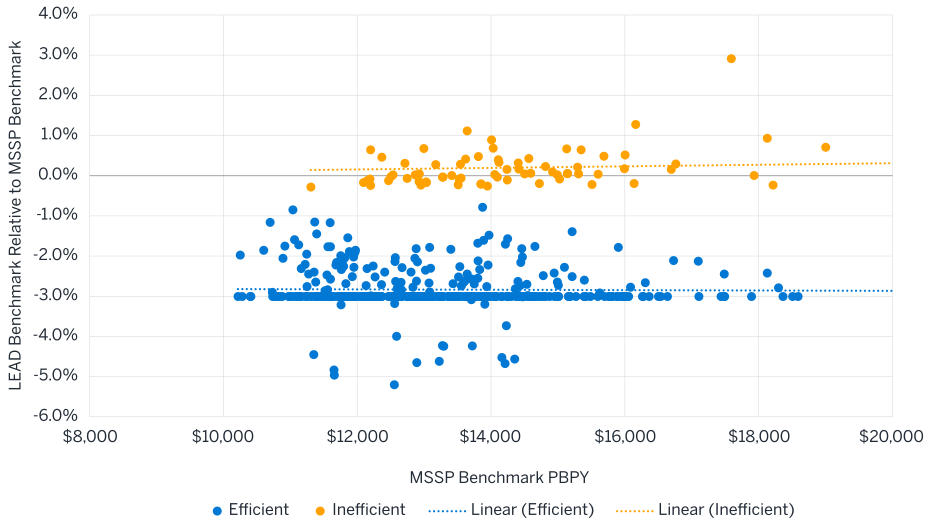
Note: Each data point is a PY2024 MSSP ACO. Benchmarks are on an actual risk score basis, not normalized to a 1.0.
2. Increased support for high-cost ACOs: LEAD supports regionally inefficient ACOs with the following key adjustments.
- An administrative add-on adjustment, which increases the benchmark
- No regional efficiency adjustment, which eliminates the gap between historical spending and the benchmark (before the impact of other adjustments)
This design may improve participation among higher-cost or historically underperforming ACOs.
3. Long-term outlook for inefficient ACOs: While LEAD offers benchmark stability through a fixed baseline period, regionally inefficient ACOs will see the discount increase each year by 0.25% from 1.75% in PY2027 to 3.00% in PY2032 and beyond. Net of the 1.50% administrative add-on, the long-term discount is then 1.50% (3.00% minus 1.50%). MSSP ACOs with agreement periods starting on or after January 1, 2024, have an overall regional adjustment floor of 0%,3 so regionally inefficient MSSP ACOs will have the benefit of no regional adjustment going forward (similar to LEAD). On the other hand, the fixed baseline period in LEAD could still benefit some ACOs.
Case study: The shared savings effect on LEAD and MSSP enhanced scenarios
Based on the LEAD methodology available in the RFA, we can model the PY2027 shared savings impact (as a percent of benchmark) of various LEAD and MSSP enhanced scenarios. We use the following simplifying assumptions.4
- No prior savings adjustment
- ACO generates positive savings in PY2027
- ACO starts a new agreement period in PY2027
- Two LEAD scenarios: benchmark adjustment cap of 3% (LEAD 3%) and 5% (LEAD 5%) to show performance for an ACO with and without prior MSSP experience
- Two MSSP scenarios: ACO in its first agreement period and ACO in its second agreement period to vary the regional adjustment blend percentage. Both these scenarios apply to MSSP ACOs beginning an agreement in 2027 (e.g., not subject to negative regional adjustment in aggregate).
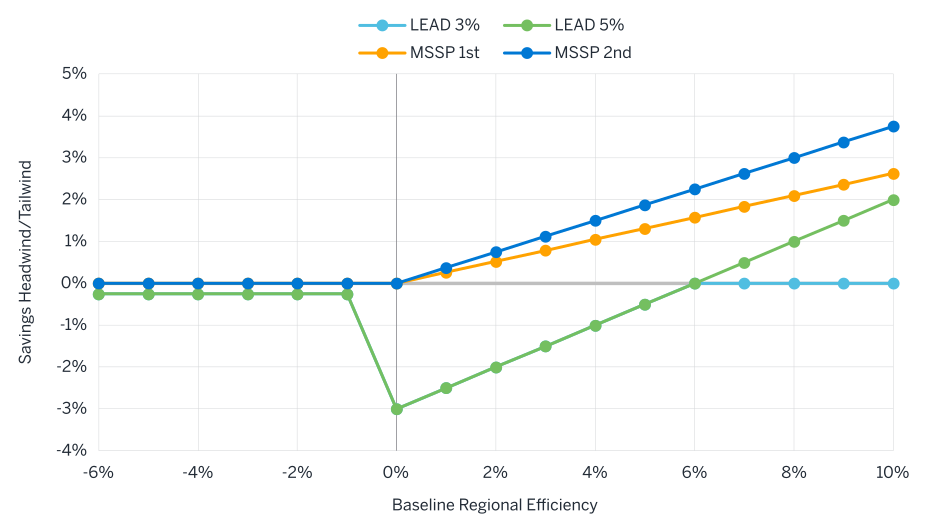
Figure 5: PY2027 Shared savings impact—LEAD vs. MSSP enhanced
Key takeaways from our LEAD case study
- Negative baseline regional efficiency: In MSSP, the 0% regional adjustment floor helps preserve the benchmark. In LEAD, the discount produces a slight financial headwind (in PY1) due to being larger than the administrative add-on benchmark adjustment. This headwind will get larger each year.
- Positive baseline regional efficiency: In MSSP, the regional adjustment drives greater savings from the second agreement period (due to higher regional blend percentage). In LEAD, the 3% cap (from having prior MSSP experience) prevents any benchmark tailwinds for higher baseline regional efficiencies. The only benchmark tailwind for an efficient ACO is if there is no prior MSSP experience and the regional adjustment (50% of baseline efficiency) is greater than the discount (i.e., needs to be 6% or more).
Conclusion: LEAD may appeal to rural or high-spending healthcare providers
The LEAD benchmarking methodology represents a meaningful shift from MSSP. While the key changes would reduce overall MSSP benchmark levels by approximately $3.2 billion or 2.3%, its effect would lower benchmarks in aggregate for efficient ACOs (-2.9%) and increase or maintain benchmarks (+0.3%) for less efficient ACOs.
This rebalancing may support broader participation from rural or higher-spending providers that have avoided Medicare ACO participation previously. However, it is unclear if LEAD will have lasting appeal as the regionally inefficient benchmark discount progresses from 1.75% to 3% over time. Individual ACOs will need to accurately quantify their regional efficiency and the impact of the high-needs population to evaluate the first-year advantages and disadvantages of LEAD. ACOs should also consider LEAD’s unique features, like cash flow enhancements, as well as the expected trade-offs around benchmark discount, risk model, benchmark stability, and other program features, as they evaluate long-term advantages and disadvantages.
1 “Regional efficiency” refers to the relationship between risk-adjusted costs of (1) an ACO’s population and (2) an ACO’s region. When this ratio is high (i.e., the ACO’s population cost is higher than its region), an ACO is considered “regionally inefficient.” In the LEAD request for application (RFA), CMMI refers to ACOs as “lower spending” (regionally efficient) or “higher spending” (regionally inefficient).
2 The LEAD RFA indicates that the benchmark adjustment (either regional efficiency or prior savings) will be capped at 3% of United States per capita costs for ACOs that were previously in MSSP, and 5% for all other ACOs. In our analysis we flagged ACOs that were previously in MSSP by the presence of a prior savings adjustment.
3 Applies to MSSP agreement period starting on or after January 1, 2024. See https://www.federalregister.gov/d/2023-24184/p-3665.
4 There are several reasons an ACO’s financial performance may not play out as indicated in Figure 5, including but not limited to positive prior savings adjustments, negative overall shared losses, and changes in the regional efficiency between the baseline period and PY2027.