A new era of reindustrialization is underway—one driven by technology and artificial intelligence (AI) and the need to build and modernize infrastructure, systems, and supply chains underpinning these advancements. It’s a transformation that demands capital at scale—capital that few institutions are equipped to deploy. Institutional investors, such as life insurers, find themselves in a unique position: managing both the increased need for retirement income for an aging population and the demand for capital from companies looking to participate in this reindustrialization. This article examines how these two trends converge and why insurers are uniquely positioned to bridge the supply of retirement capital with the surging demand for long-term infrastructure investment.
From Industrial Revolution to AI: Three eras of economic transformation
The U.S. experienced three significant transitional periods of the global economy:
- The Industrial Revolution (c. 1760–c. 1840) produced physical goods and infrastructure, changed factory labor practices, created urbanization, and was powered by steam engines and mechanization of manual processes.
- The Technological Revolution (c. 1870–c. 1914) produced electrified systems and mass-production of consumer goods, changed consumer culture and corporate capitalism, and was powered by electricity.
- The Information Age (since 1947) has produced software and digital services, has changed global connectivity and digital economies, and is powered by microchips, networks, and the internet.
In summary, the Industrial Revolution built the physical infrastructure, the Technological Revolution electrified and automated it, and the Information Age digitized and connected it globally. Where are we now? We may be at the onset of the Reindustrialization Era.
Today’s reindustrialization is a break from form—companies are not just rebuilding factories and infrastructure. Rather, this reindustrialization refers to a modernization, or an upgrade if you will, away from aging physical and digital infrastructure to a modern, scalable, digitally enabled industrial machine. Based on observable trends in the U.S. life and annuity industry, this latest revolution may be powered by AI. It will be supported in part by the balance sheets of life and annuity insurance companies.
The balance of this paper examines the following interrelated dynamics:
- Significant capital expenditures will be required to achieve the reindustrialization described above.
- Among financial intermediaries, life insurers are in a unique position to provide a portion of this capital.
- However, the insurance industry itself will need to invest significant capital in order to reinvent itself.
- Insurers that successfully make this transition should thrive, generate more capital, and therefore be better positioned to contribute capital to the reindustrialization of the broader economy.
AI infrastructure investment: Key trends shaping capital markets
AI is positioned to transform global industries but requires a significant buildout of the physical infrastructure necessary to support it. Major firms like Brookfield and Apollo, and others like them, have already announced significant expenditures. Such firms may use the assets on the balance sheets of their insurance affiliates/insurance client partners to partially fund these buildouts.
In August 2025, Brookfield estimated a $7 trillion spend on AI-related infrastructure in the next 10 years. It went on to state that this “is a once-in-a-generation opportunity where only strong operators with solid market understanding and access to the right operational assets will ultimately succeed.”1
Around the same time, Apollo published an article highlighting that four hyperscalers (Alphabet, Amazon, Meta, and Microsoft) are expected to exceed $350 billion in capital expenditures (i.e., long-term investment) in 2025.2 This figure increased to approximately $650 billion for 2026.3 From 2022 to 2025, Apollo has deployed approximately $38 billion in next-generation infrastructure, digital platforms, and compute capacity.4 In June 2024, it announced its intent to acquire 49% of Intel’s manufacturing facility in Ireland for $11 billion.5
An implication of the above may suggest that the calls for loans to build this infrastructure may no longer be fielded to (small) regional banks but to (large) asset managers with access to billions of statutory capital and surplus on partner insurance company balance sheets.
How life and annuity insurers are adapting to the Reindustrialization Era
Many insurance companies are facing increased pressures amid the wave of AI advancements. Companies with decades-old systems are slower to develop new products, experience increased costs, and have limited agility to react in an ever-advancing technological environment. Changing customer expectations for digital onboarding, real-time services, personalized products, and transparency in pricing have pushed insurers to digitalize their capabilities. Record annuity sales, and the need to scale operations successfully, are driven by heightened awareness of retirement security with an estimated 82 million retirees by 2050.6
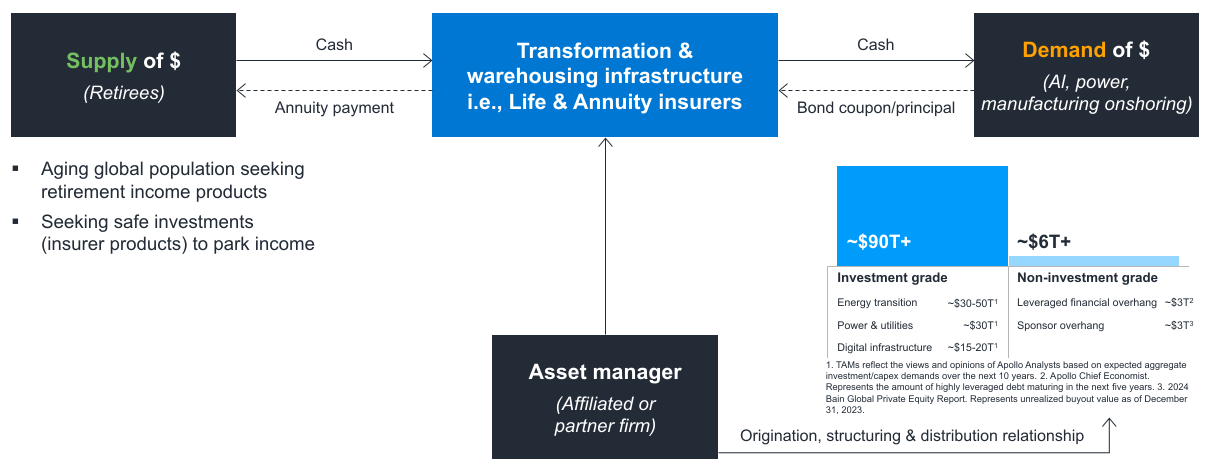
Participating in the recent record annuity sales requires both strong distribution capabilities and attractive products (i.e., higher crediting rates driven by asset alpha). Participating in funding the reindustrialization requires the ability to rapidly bring to bear large amounts of capital and to provide the funding across the capital structure (e.g., structured debt, preferred equity, etc.). Insurers paired with asset managers sit in a unique position to participate in both the incoming supply of funds (from retirees or those nearing it) and deploy part of it toward the growing demand for funds (from companies participating in the reindustrialization). Insurers serve as a key lynchpin to warehouse the funds, transform it into an insurance product, and deploy it into productive non-cash assets.
A visualization is shown in Figure 1.
Figure 1: Flowchart of where insurers sit in the supply and demand of funds7
There are already examples of this architecture in play:
- Athene merged with Apollo in 2022.
- American Equity Investment Life (2024), Argo Group (2023), and American National Group (2022) were each acquired by Brookfield.
- AIG and Resolution Life announced strategic partnerships with Blackstone in 2021.
Some of these asset managers and private equity firms (AM-PEs) may utilize the long-dated nature of the liabilities on their insurance affiliate’s/partner’s balance sheet to invest in credit, namely AI (including digital and physical infrastructure), power, energy, and utilities.
Now, back to the original prompt: how insurance companies prepare. Some are doing more than others. Entities that are already owned by or partnered with large AM-PEs are well positioned to ride the wave of reindustrialization. These insurers, through their partnerships, enjoy the availability of scarce assets, high-quality, long-duration, yield-rich assets that match the insurers’ liabilities but are limited in supply. The insurance entities that have not partnered with AM-PEs will want to consider whether access to differentiated assets/asset classes would benefit their competitive positioning for their product suite.
Another potential outcome? An increase in the consolidation of insurance entities by AM-PEs with target insurers being ones that may not have scale in asset management or distribution. This outcome is not unprecedented. During the 1800s, many companies were building railroads in conjunction with the industrial and technological revolutions at the time. During that time, the railroad industry went through cycles of volatility, and many companies were consolidated to sustain the industry. That said, few would argue that building railroads was a bad idea. This highlights the need for prudence and risk management, a core capability of the life and annuity industry, as insurers evaluate investment opportunities.
Next steps for insurers, asset managers, and capital providers
For insurers, asset managers, and capital providers—those who help to finance the U.S. and global reindustrialization trend—actuarial analytics can provide clear decision-making support:
- Implications to product pricing generated by asset alpha
- Capital implications from different asset classes/strategies
- Asset-liability management considerations of evolving asset strategies all in the context of a rapidly evolving insurance regulatory environment
What we’ve seen so far is that insurers continue to consider entering partnerships with asset managers, focusing on holistic economic impacts of those that often incorporate broader mandates. Rather than just third-party asset management agreements, many of these partnerships may also pair capital generation (e.g., in a sidecar structure) and/or an in-force block reinsurance with a reinsurer affiliated with the asset manager.
Asset managers continue to explore the implications of certain asset classes in the U.S., Bermuda, the U.K., and other jurisdictions/regulatory environments, including how to optimize asset strategies based on where their partner insurer is domiciled.
Moving forward, insurance capital providers need to work with actuaries and risk managers to understand the varying nature and unique features of insurance liabilities (from simple to complex products), the nuances of regulatory regimes (especially when recognizing the number of reinsurers that operate across multiple jurisdictions, e.g., the U.S., Bermuda, and Japan), and how actuarial assumptions used by an insurer compare to industry experience for similar products.
We are at a unique juncture in the evolution of technology and globalization. The mix of global reindustrialization and aging populations creates significant opportunities for insurers to thrive. Insurers that successfully reinvent themselves will continue to play an essential role as a conduit of funds, fueling the global transformation engine by linking suppliers of capital with those in need.
1 Brookfield. (August 2025). Building the backbone of AI. Retrieved April 1, 2026, from https://www.brookfield.com/sites/default/files/documents/Brookfield_Building_the_Backbone_of_AI.pdf.
2 Apollo. (August 6, 2025). Spotlight: Financing the digital infrastructure surge. Retrieved April 1, 2026, from https://www.apollo.com/insights-news/insights/2025/08/spotlight-financing-the-digital-infrastructure-surge#accordion-77d987aa5b-item-927dabc992.
3 Slok, T., Shah, R., & Galwankar, S. (February 2026). Putting the total amount of hyperscaler capex into perspective. Apollo. Retrieved April 1, 2026, from https://www.apolloacademy.com/wp-content/uploads/2026/02/Hyperscaler-capex-022226_v2.pdf#:~:text=The%20amount%20of%20money%20being.
4 Apollo. (August 6, 2025), op cit.
5 Reuters. (June 4, 2024). Apollo Global to provide $11 billion to Intel for Ireland facility. CNBC. Retrieved April 1, 2026, from https://www.cnbc.com/2024/06/04/apollo-global-11-billion-to-intel-for-ireland-facility.html.
6 Apollo. (October 1, 2024). Investor Day 2024. Retrieved April 1, 2026, from https://ir.apollo.com/_assets/_6f06ca6ad98e3d449c90410af7124957/apollo/db/2224/21725/pdf/Apollo+2024+Investor+Day+Presentation+.pdf.