Executive summary
- Maximum Fair Price (MFP) implementation in Medicare Part D reshapes the economics of the pharmacies and providers that dispense these drugs.
- Pharmacies may change stocking behaviors, even for drugs with universal coverage, depending on the manufacturers’ refund approach and drug channel economics.
- Illustrative modeling shows that a manufacturer's choice of refund benchmark, not the negotiated price itself, is often the primary driver of whether dispensing remains economically viable, especially for small and independent pharmacies.
- A manufacturer's effectuation decisions can shift dispensing incentives across an entire therapeutic class, affecting competitors whose products were never selected.
Pharmacies face challenges in the next waves of MFP pricing
Medicare drug price negotiation to determine MFP under the Inflation Reduction Act of 2022 (IRA) has reshaped the reimbursement environment for selected Part D drugs.1 Although attention to MFP has focused mainly on manufacturer pricing and Medicare savings, early analyses anticipated that a substantial portion of the operational burden would fall to the pharmacies responsible for purchasing, stocking, dispensing, and awaiting manufacturer refunds through the new Medicare Transaction Facilitator (MTF) process, even as payer reimbursement timing has remained unchanged.2 Early 2026 experience has borne this out, with pharmacies reporting refund delays well beyond the statutory window.3
This dynamic introduces new risk for manufacturers. Even when products remain on formulary, pharmacies may alter stocking or dispensing behavior. As stakeholders navigate the early waves of MFPs, the full implications across the pharmaceutical value chain are still unfolding.
Because of the cost of specialty medications and their growing representation in MFP selection, they pose a concern for pharmacies in the form of reimbursement timing and working capital. For MFP initial price applicability year (IPAY) 2026, three of the 10 selected drugs were high-cost specialty therapies, including one oncology product. In contrast, roughly half of the 15 drugs selected for IPAY 2027 can be classified as specialty, including four oncology therapies. This shift signals a meaningful increase in the concentration of financially impactful specialty drugs entering MFP negotiation.4 For oncology drugs and other specialty drugs covered by Medicare Part D, the outcome of price negotiations has the potential to change the stocking and dispensing dynamic from “business as usual” to tough financial decisions for pharmacies, particularly smaller or independent ones.
How MFP shifts financial risk to the pharmacy dispensing channel
From the pharmacy perspective, two concerns dominate: 1) Operational complexities from delayed manufacturer reimbursements and 2) margin uncertainty and potential revenue compression on certain MFP-eligible brands. We describe the dynamics of these elements in more detail below. For simplicity, these processes apply only to branded drugs, not generics or biosimilars.
Pharmacy reimbursement dynamics
The availability of working capital during the procurement, dispensing, and reimbursement timeline of drugs differs for non-MFP and MFP-eligible drugs (Figure 1).
Non-MFP: Reimbursement resembles the classic cash-flow model:
- Procurement: The drug is purchased at or near the wholesale acquisition cost (WAC).
- Dispensing: Patient cost sharing is collected at the pharmacy and is based on the reimbursed price.
- Reimbursement: The pharmacy benefit manager (PBM) reimburses the pharmacy based on a discount from the average wholesale price (AWP) or WAC plus a dispensing fee, or under other contractual arrangements. Under the Centers for Medicare and Medicaid Services (CMS) prompt pay rules, PBMs have up to 14 days to make this payment following claim submission.5
MFP-eligible: The process differs by patient eligibility and the manufacturer’s effectuation model (Figure 1):6
- Procurement: The drug is purchased based on either MFP or near (though generally below) WAC.7
- Dispensing: For Medicare beneficiaries, patient cost sharing is calculated based on MFP (rather than WAC or AWP) and is collected at the pharmacy.
- Reimbursement:
- For non-Medicare patients
Similar to non-MFP drugs, the PBM reimburses the pharmacy within 14 days of receiving a claim, typically based on negotiated discounts, either WAC or AWP, plus a dispensing fee. - For Medicare patients
The PBM reimburses the pharmacy based on MFP plus a dispensing fee, similar to the non-MFP baseline, though the underlying MFP benchmark is lower than WAC/AWP. Some network contracts may apply a higher dispensing fee for MFP claims. The timing of reimbursement can vary depending on how the discount is applied. - Retrospective reimbursement (used for all IPAY 2026 selected drugs):
- The pharmacy carries the spread between WAC and MFP as a receivable until the manufacturer refund is processed.
- The MTF serves as the operational bridge. The PBM/plan submits the claim to the MTF within seven days, and the manufacturer then has up to 14 days to reimburse the pharmacy for the difference between MFP and acquisition cost or WAC—extending total reimbursement exposure to approximately Day 21. In some early implementation experience, reimbursement timing has been longer than that.
- Prospective price concession (permitted but not used for IPAY 2026):
- The pharmacy acquires the drug at MFP, so acquisition cost and point-of-sale reimbursement are aligned from the start.
- No manufacturer refund is generated, and the MTF Payment Module is not engaged.
- Total reimbursement exposure is solely the PBM prompt-pay window, up to 14 days, with no additional working capital gap.
Figure 1: Retrospective reimbursement model for MFP-eligible drugs
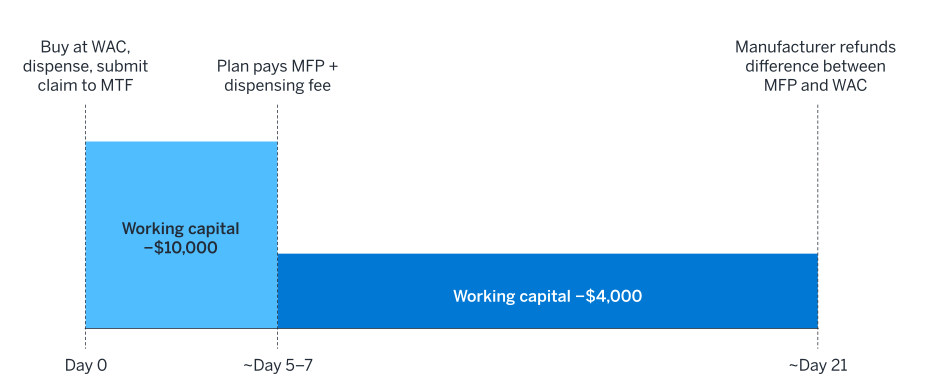
Under the retrospective pharmacy reimbursement model, the pharmacy funds the WAC-to-MFP spread from drug acquisition until the manufacturer refund arrives, which is roughly a three-week exposure at best. Reimbursement can exceed 21 days if verification edits are under review (up to 90 days) before submission to the manufacturer. Claims that may be subject to 340B may also cause delays in reporting, validating, and processing. Assumptions: $10,000 WAC and acquisition cost, $6,000 MFP, single fill. Illustrative model.
MFP, Maximum Fair Price; MTF, Medicare Transaction Facilitator; WAC, wholesale acquisition cost.
In practice, all 10 manufacturers of IPAY 2026 selected drugs elected to use the MTF Payment Module, the mechanism through which retrospective refunds are transmitted to dispensing entities.8 Manufacturers' effectuation plans are not public, but reported approaches already vary.9 Some apply the Standard Default Refund Amount (SDRA), defined as WAC minus MFP, which refunds the full list-price spread regardless of what the pharmacy actually paid; others refund only the difference between the pharmacy's contract price and MFP. The choice of benchmark is a manufacturer decision, not a fixed feature of the program, and it determines how much of its acquisition discount a pharmacy retains.
Margin effects
The direction of the margin effect is not uniform. We see compression in some cases but expansion in others. Whether a pharmacy’s per-script margin on Medicare volume rises or falls depends on the manufacturer’s choice of refund method rather than on the negotiated price itself.
Total pharmacy sales revenue depends on both the initial drug cost and reimbursement rate. For a Medicare claim under MFP, patient cost sharing and PBM reimbursement are based on the lower MFP rather than the reimbursement rates that applied prior to MFP. Although the manufacturer reimburses the pharmacy for the difference between MFP and WAC, overall revenue on that claim is lower than under the prior, non-MFP reimbursement (Figure 2). Whether the pharmacy’s margin is also lower is a separate question, which depends on how the manufacturer calculates the refund. The direction of that effect depends on a single variable: Under the SDRA, a pharmacy is reimbursed back to WAC, so its margin change equals the difference between its pre-MFP reimbursement and WAC. Where reimbursement historically was below WAC, as is common for community pharmacy-acquired specialty drugs, the pharmacy retains its full acquisition discount, and per-script margin improves by the amount of that gap. Where reimbursement historically exceeded WAC, as is often the case in certain pharmacy settings such as long-term care, capping reimbursement at MFP is a headwind regardless of which refund benchmark the manufacturer selects. Compression can also arise from adjacent decisions: exclusion of MFP units from purchase-based rebates or a reduction in WAC toward MFP.
For drugs in competitive classes, where negotiated channel discounts can be meaningful, this election can be a determining factor in whether dispensing a specific product remains economically viable. The same pharmacy dispensing the same drug can therefore see materially different economics depending on which refund methodology the manufacturer elects—from retaining full acquisition discount to retaining only the dispensing fee.
Figure 2: The manufacturer’s choice of refund method can impact pharmacy margin
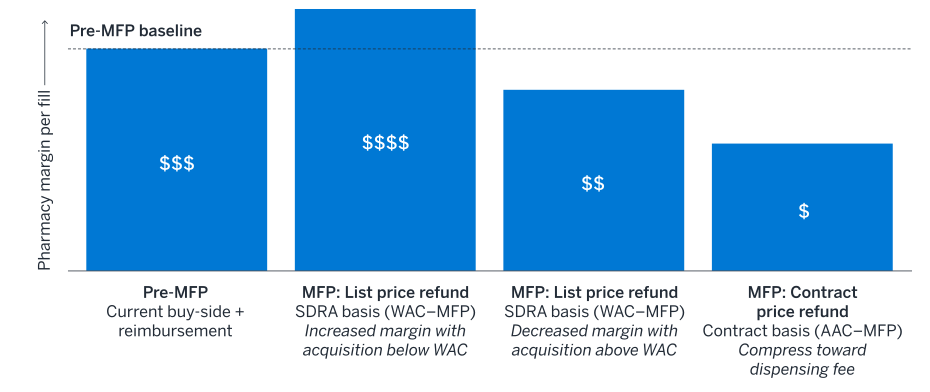
Illustrative per-fill margin for the same drug at the same pharmacy under the retrospective reimbursement model. Reimbursement is capped at MFP under both MFP paths. A list-price (SDRA) refund can leave margin above or below its pre-MFP level depending on the pharmacy's acquisition terms, whereas a contract-price refund compresses margin toward the dispensing fee. The manufacturer's refund benchmark—list price versus contract price—determines how much the pharmacy retains.
AAC, average acquisition cost; MFP, Maximum Fair Price; SDRA, Standard Default Refund Amount; WAC, wholesale acquisition cost.
As high-cost oral oncology drugs and other specialty drugs undergo MFP price negotiation, the financial stakes for pharmacies rise materially, with even greater pressures anticipated for provider-administered drugs under future rounds of MFP, where buy-and-bill acquisition economics depend directly on the margin between acquisition cost and reimbursement.10
Pharmacy responses to MFP pressure may influence stocking behavior
Below are three pressure points facing pharmacies that may impact stocking and dispensing of MFP-eligible drugs:
Working capital and cash flow pressure
Pharmacies may acquire MFP drugs at or near WAC but are reimbursed at MFP plus a dispensing fee at the point of sale. The manufacturer refund ultimately restores the pharmacy to its acquisition cost or WAC, so working capital exposure is ultimately one of timing, not payment. Although CMS has reduced Prescription Drug Event (PDE) submission timelines for MFP-selected drugs to approximately seven days, pharmacies remain exposed to reimbursement lag, as manufacturer refunds are contingent on PDE submission, processing, and validation through the MTF.11 Manufacturer 340B reviews may cause additional delays in reimbursement. This payment lag may introduce delays between dispensing and final reimbursement. In response, pharmacies may shift stocking behavior across channels, favoring non-MFP economics where feasible and limiting exposure to MFP-driven cash flow risk.
Figure 1 illustrates the scale of that exposure on a single fill: The pharmacy acquires the drug at $10,000 WAC, then dispenses the drug and bills the claim, and the plan reimburses $6,000 at MFP plus a dispensing fee, leaving the pharmacy roughly $4,000 short of its acquisition cost. That gap stays open until the manufacturer refund is processed, potentially 21 or more days after claim submission. The gap scales directly with volume; a pharmacy dispensing 10 fills per month has roughly $40,000 of working capital tied up in a single product at any given time. For independent or smaller specialty pharmacies with limited credit lines, this working capital gap is not merely inconvenient—it may be operationally prohibitive.
Margin uncertainty and channel-specific compression
As Figure 2 shows, the same pharmacy dispensing the same fill can land above or below its pre-MFP margin depending solely on which refund benchmark the manufacturer elects. Compression concentrates in the contract-price case, specifically where a pharmacy's pre-MFP margin depended on an acquisition discount that the refund methodology does not preserve.
Health system specialty pharmacies and other internal dispensing operations may face margin compression if their acquisition costs were below prior reimbursement amounts and manufacturers elect a contract-price refund benchmark. For in-office dispensing pharmacies purchasing under negotiated terms, the economics may differ from retail. Profitability on MFP volume is therefore uncertain at the point of the stocking decision, not necessarily lower. Manufacturers responding to MFP with list-price reductions may also compress pharmacy margin in commercial lines of business; that dynamic falls outside the Medicare scope of this paper.
Operational burden and dispute management
Tracking prescription-level liabilities and managing disputed refund amounts with manufacturers and CMS creates an administrative burden that affects both reimbursement timing and margin certainty.
Based on the pressures listed above, pharmacies theoretically could elect not to stock MFP-eligible drugs, particularly small and/or independent pharmacies. This could potentially cause supply chain issues.
In survey results reported to CMS in September 2025, the NCPA found that nearly one in five pharmacists said they would not stock drugs in the negotiation program, and another 67% said they might not, citing cash flow concerns under MFP effectuation.12 Independent pharmacy sentiment may not represent the entire market, but it sends an early warning signal: If pharmacies perceive MFP implementation as creating reimbursement delay, inventory risk, or margin uncertainty, stocking behavior may become less predictable.13
Early 2026 implementation experience has begun to bear this out. Following the first wave of MFP effectuation, 67% of pharmacies waited more than 22 days for manufacturer refunds from the date of service, and roughly 22% waited more than 28 days—well beyond the 21-day exception.14 NCPA has asked CMS to expedite payments and encourage manufacturers to adopt SDRA as a known and reliable refund figure.15
What manufacturers should evaluate today about pharmacy reimbursement dynamics
Manufacturers have addressed pharmacy reimbursement dynamics in various ways in the past, but the landscape is shifting under MFP, especially for high-cost drugs in certain classes, such as oncology. CMS requires manufacturers to include, as part of their effectuation plans, processes for mitigating material cash flow concerns for dispensing entities that self-identify, such as expedited payment timelines.16 Early implementation experience suggests those plans have not yet resolved the underlying timing pressures.17 Because of the inherent instability in the system, pharmacy reimbursement considerations for manufacturers in the MFP era should include:
- Financial: What is the working capital impact on pharmacies dispensing MFP-eligible products? Are your refund timelines competitive? Could proactive payment terms reduce pharmacy friction?
- Operational: Are your MTF and refund dispute processes creating unnecessary complexity? Can you simplify or accelerate the refund cycle?
- Patient access: Are pharmacies in your distribution network signaling stocking changes for MFP-eligible products? Do you have real-time visibility into dispensing pattern shifts?
- Strategic: What are the trade-offs between prospective and retrospective reimbursement payment models for your portfolio? How do lessons from Part D MFP inform the approach to Part B drugs entering negotiation?
- Competitive: If your product competes in a class with an MFP-selected drug, how do your channel economics compare with the post-MFP dispensing economics of the selected product? A competitor's refund methodology decisions can shift dispensing incentives across an entire class.
Answers to each of these questions are quantifiable. Scenario modeling of refund methodologies, channel contract structures, and working capital requirements—grounded in claims-informed utilization data—can convert MFP effectuation from an operational unknown into a set of measurable trade-offs before the next price applicability year begins.
The IRA and MFP are the most recent chapters in an evolving process for providing affordable prescription drug access for Medicare beneficiaries. Manufacturers who understand the shifting sands of MFP and pharmacy reimbursement dynamics will be better prepared for the next wave of MFP drug selection and price negotiation.
Lessons from today’s MFP negotiations chart a path for future pharmacy strategy
Manufacturers, Medicare, and pharmacies form an integrated system that provides patient access to Part D drugs. Oncology drugs are a test case for determining the way pharmacies are compensated for their role in distributing potentially high-cost drugs to Medicare beneficiaries.
- Coverage does not equal access. The IRA requires that MFP-negotiated drugs remain on payer formularies, but formulary inclusion does not guarantee dispensing. Pharmacies and providers retain discretion over stocking and dispensing decisions, and if MFP economics create sufficient friction, operational decisions may change, even for drugs with full formulary coverage.
- Pharmacy economics is a market access decision. MFP moves refund methodology, payment terms, and channel engagement out of contracting operations and into lifecycle strategy, where they sit alongside formulary access and competitive positioning.
- Part D is here. Part B is next. Milliman previously examined the distinct dynamics facing provider-administered drugs as negotiation expands beyond Part D.18 The pharmacy experience described in this paper is the leading indicator for those economics. Manufacturers with products and competitors in future MFP negotiation rounds should be building their pharmacy and provider strategy now.
1 H.R.5376 - An act to provide for reconciliation pursuant to title II of S. Con. Res. 14. (2022, August 16). 117th Congress (2021-2022). Retrieved September 30, 2026, from https://www.congress.gov/bill/117th-congress/house-bill/5376/text.
2 Coster, J.M. (2025, October 16). Operational and policy considerations in the effectuation of Medicare’s maximum fair drug prices for Part D. USC Leonard D. Schaeffer Institute for Public Policy & Government Service. Retrieved September 30, 2026, from https://schaeffer.usc.edu/research/medicare-drug-prices-mfp-effectuation/.
3 Hauser, R.B. (2026, February 26). MTF survey letter: Report for February 2026 survey of independent pharmacy owners/managers. National Community Pharmacists Association. Retrieved September 30, 2026, from https://www.ncpa.co/pdf/2026/advocacy/mtfsurveyletter.pdf.
4 HHS announces 15 additional drugs selected for Medicare drug price negotiations in continued effort to lower prescription drug costs for seniors [Press release]. (2025, January 17). Centers for Medicare and Medicaid Services. Retrieved September 30, 2026, from https://www.cms.gov/newsroom/press-releases/hhs-announces-15-additional-drugs-selected-medicare-drug-price-negotiations-continued-effort-lower.
5 Prompt payment by Part D sponsors. (2026, August 13). 42 C.F.R. § 423.520. Retrieved September 30, 2026, from https://www.ecfr.gov/current/title-42/chapter-IV/subchapter-B/part-423/subpart-K/section-423.520.
6 Some details of manufacturer plans under the MDPNP are available. (2025, October 2). National Community Pharmacists Association. Retrieved September 30, 2026, from https://ncpa.org/newsroom/qam/2025/10/02/some-details-manufacturer-plans-under-mdpnp-are-available.
7 Klomp, C. (2025, September 30). Medicare Drug Price Negotiation Program: Final guidance, implementation of Sections 1191–1198 of the Social Security Act for Initial Price Applicability Year 2028 and manufacturer effectuation of the Maximum Fair Price in 2026, 2027, and 2028. Centers for Medicare & Medicaid Services. Retrieved September 30, 2026, from https://www.cms.gov/files/document/ipay-2028-final-guidance.pdf.
8 Manufacturers' MDPN implementation plans have been posted to the Medicare Transaction Facilitator. (2025, September 22). National Community Pharmacists Association. Retrieved September 30, 2026, from https://ncpa.org/newsroom/qam/2025/09/22/manufacturers-mdpn-implementation-plans-have-been-posted-medicare.
9 Some details of manufacturer plans under the MDPNP are available. (2025, October 2). National Community Pharmacists Association. Retrieved September 30, 2026, from https://ncpa.org/newsroom/qam/2025/10/02/some-details-manufacturer-plans-under-mdpnp-are-available.
10 Holcomb, K., Klaisner, J., & Simenc, D. (2026, February 18). Medicare drug price negotiation: New dynamics as the tide turns to Medicare Part B. Milliman. Retrieved September 30, 2026, from https://www.milliman.com/en/insight/medicare-drug-price-negotiation-part-b-dynamics.
11 Coster, J.M. (2025, October 16). Operational and policy considerations in the effectuation of Medicare’s maximum fair drug prices for Part D. USC Leonard D. Schaeffer Institute for Public Policy & Government Service. Retrieved September 30, 2026, from https://schaeffer.usc.edu/research/medicare-drug-prices-mfp-effectuation/.
12 Hoey, B.D. (2025, September 3). Re: Concerns about the Medicare Drug Pricing Negotiation Program. National Community Pharmacists Association. Retrieved September 30, 2026, from https://ncpa.org/sites/default/files/2025-09/9-3-2025-NCPA-CMS-MDPN-recs.pdf.
13 Fein, A.J. (2022, September 13). The Inflation Reduction Act: Three unintended consequences for biosimilars, health plans, providers, and pharmacies. Drug Channels. Retrieved September 30, 2026, from https://www.drugchannels.net/2022/09/the-inflation-reduction-act-three.html.
14 Hauser, R.B. (2026, February 26). MTF survey letter: Report for February 2026 survey of independent pharmacy owners/managers. National Community Pharmacists Association. Retrieved September 30, 2026, from https://www.ncpa.co/pdf/2026/advocacy/mtfsurveyletter.pdf.
16 Klomp, C. (2025, September 30). Medicare Drug Price Negotiation Program: Final guidance, implementation of Sections 1191–1198 of the Social Security Act for Initial Price Applicability Year 2028 and manufacturer effectuation of the Maximum Fair Price in 2026, 2027, and 2028. Centers for Medicare and Medicaid Services. Retrieved September 30, 2026, from https://www.cms.gov/files/document/ipay-2028-final-guidance.pdf.
17 Hauser, R.B. (2026, February 26). MTF survey letter: Report for February 2026 survey of independent pharmacy owners/managers. National Community Pharmacists Association. Retrieved September 30, 2026, from https://www.ncpa.co/pdf/2026/advocacy/mtfsurveyletter.pdf.
18 Holcomb, K., Klaisner, J., & Simenc, D. (2026, February 18). Medicare drug price negotiation: New dynamics as the tide turns to Medicare Part B. Milliman. Retrieved September 30, 2026, from https://www.milliman.com/en/insight/medicare-drug-price-negotiation-part-b-dynamics.