Introduction
The Medicare Inpatient Prospective Payment System (IPPS) reimburses hospitals based on Medicare Severity Diagnosis-Related Groups (MS-DRGs). Although this system promotes efficiency by establishing a predetermined rate for each type of inpatient stay, it can create financial barriers for hospitals considering adopting innovative, though often high-cost, medical services or technologies. These barriers are eventually overcome as the Centers for Medicare and Medicaid Services (CMS) recalibrates relative cost weights in the MS-DRGs to reflect new cost patterns. To address this tension in the nearer term, CMS implemented the New Technology Add-on Payment (NTAP) program, which provides supplemental payments for qualifying new technologies in addition to its standard payment rate for inpatient services.1 The NTAP program’s footprint has been growing steadily since its inception in 2001; in its FY 2027 IPPS final rule, CMS estimated aggregate NTAP spending of approximately $1.74 billion across all continued and newly approved technologies.2
This paper provides an overview of the NTAP program, including regulatory background and program requirements, a look at recent approval trends, and considerations for life sciences organizations aiming to improve access for new treatments and devices that would be used in the inpatient setting.
NTAP background
NTAPs are supplemental payments made under the IPPS for new medical technologies, including devices, pharmaceutical drugs, biologics, and diagnostic equipment, that may be inadequately reimbursed by existing MS-DRG payments. Without NTAPs, hospitals may face a financial disincentive to adopt new technologies. NTAPs partially close this gap, enabling patient access to innovative treatments within the Medicare fee-for-service (FFS) inpatient setting.
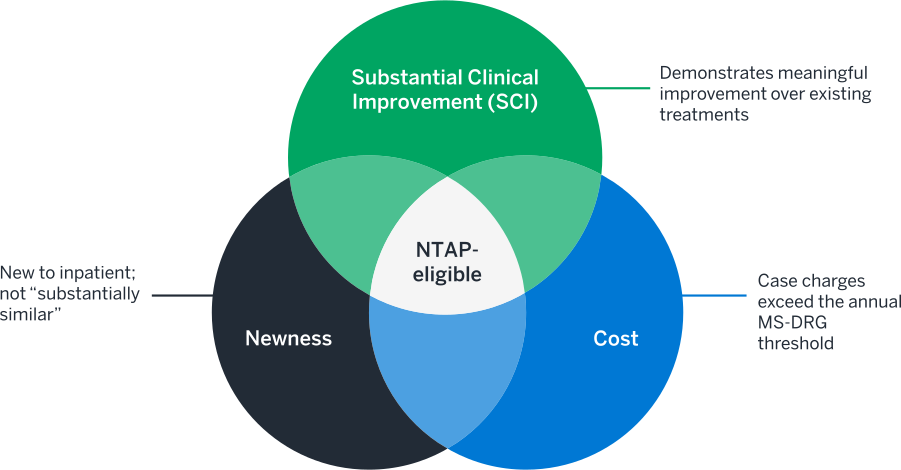
To qualify for NTAP, CMS requires that the technology satisfy three criteria:3
- Newness criterion: The technology must be new to the inpatient setting, generally within two to three years of FDA approval or market entry
- Cost criterion: Charges for cases involving the new technology must exceed the MS-DRG payment thresholds defined in the annual IPPS Final Rule
- Substantial clinical improvement (SCI) criterion: The technology must represent a substantial clinical improvement over existing treatments or treat a condition or subset of a condition’s patient population for which no current treatment exists
Figure 1: NTAP eligibility core criteria
Historically, all NTAP applicants were required to demonstrate all three eligibility criteria. Beginning in 2020, CMS established two alternative pathways that exempted certain categories of technologies from the newness similarity assessment and the SCI requirement:4
- Breakthrough Devices: Technologies with FDA Breakthrough Device designation.
- Qualified Infectious Disease Products (QIDPs) and Limited Population Pathway for Antibacterial and Antifungal Drugs (LPADs): Antimicrobial products designated as QIDPs by FDA and technologies approved through the FDA's LPAD pathway
Under these alternative pathways, technologies are only required to meet the cost criterion and be within the newness period, making the approval process substantially easier for qualifying technologies. Approval rates for alternative pathways applications are nearly always approved compared with a less than 50% approval rate for traditional pathways applicants.5,6,7 However, in the FY 2027 IPPS final rule, CMS finalized the repeal of the alternative pathways beginning with FY 2028 applications. All future applicants must demonstrate they meet every eligibility criterion, including SCI. Technologies already receiving NTAP under the alternative pathway are grandfathered and remain eligible while they continue to qualify.8
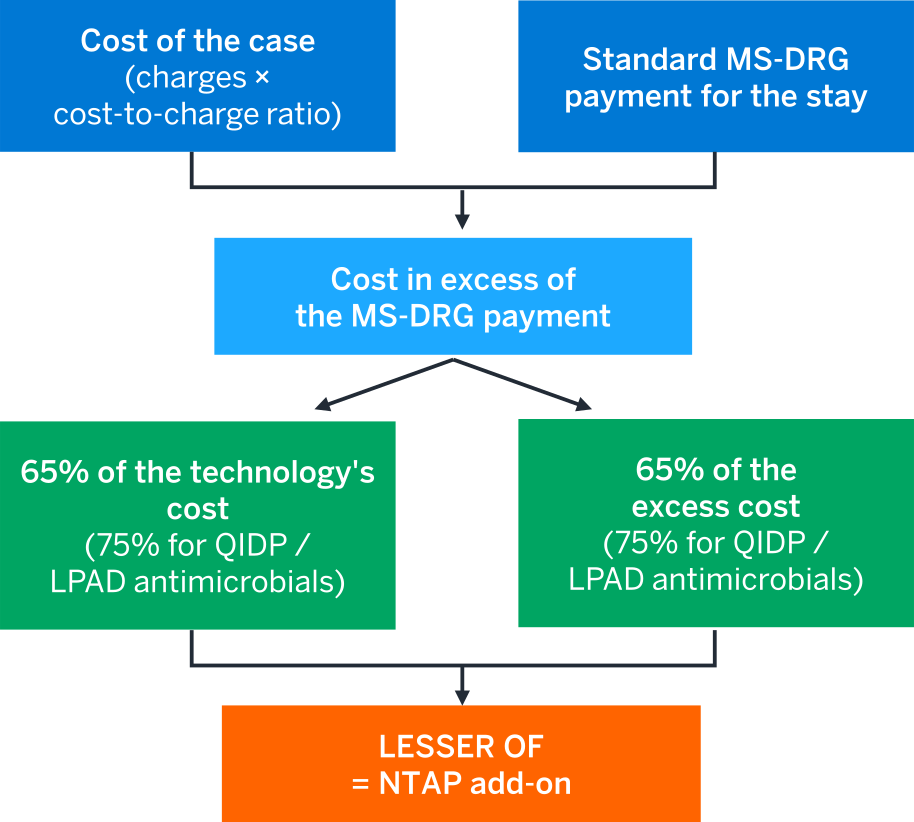
The size of the NTAP add-on payment is capped and calculated on a case-by-case basis. For most technologies, NTAP pays the lesser of 65% of the technology's cost or 65% of the amount by which the case's cost exceeds the standard MS-DRG payment. The cap increases to 75% for antimicrobials designated as a QIDP or approved under the Limited Population Pathway for Antibacterial and Antifungal Drugs (LPAD) pathway. Figure 2 walks through the calculation.9
Figure 2: NTAP add-on payment calculation
NTAP application timeline and payment lifespan
Application timeline
The NTAP application cycle follows the annual IPPS rulemaking calendar. Life science companies typically begin planning 18–36 months ahead of the U.S federal government’s fiscal year (October 1st through September 30th) for which they plan to seek NTAP approval. Life science companies should consider the following timing horizons when planning to apply for an NTAP via the traditional pathway:
- 18–36 months pre-submission: Begin building the SCI evidence package; design comparative studies with existing treatments
- 12–15 months pre-submission: Perform cost criterion analysis; identify and analyze target MS-DRGs and inpatient cases that correspond to the target patient population
- 6–9 months pre-submission: Compile application materials; coordinate FDA approval timeline with CMS submission deadlines
- Submission (Oct–Nov): Complete application with cost analysis, clinical evidence, and FDA marketing authorization documentation
- Post-proposed rule (Apr–Jun): Respond to CMS questions during public comment period; submit additional data if requested
- Post-final rule (Aug): If approved, prepare hospitals for charge capture and coding; if denied, evaluate reapplication strategy
- New fiscal year begins (Oct): Hospitals adopting NTAP-covered treatments begin receiving supplemental reimbursement.
Figure 3: NTAP application timeline

NTAP payment duration
NTAP payments are temporary by design, so proactive access activities, such as hospital education, will maximize the value of NTAP approval to hospitals and encourage product adoption. Once a product receives NTAP approval, CMS begins to collect cost data for the new technology for a period of not less than 2 years and not more than 3 years.10 Once CMS accumulates sufficient claims data, it recalibrates MS-DRG weights to reflect the cost of the technology and removes the add-on payment, and the product’s NTAP discontinues.
The “newness” period generally begins on the date of FDA marketing authorization or, if later, the date of commercial availability on the U.S. market. However, CMS has consistently applied the principle that the newness clock starts when inpatient claims data begin to become available, not necessarily on the FDA approval date.11 Figure 4 illustrates the NTAP lifespan for a hypothetical product. Actual timing varies with data availability and CMS's annual recalibration decisions.
Figure 4: Lifespan of an NTAP-approved product
| Event | Date | Implication |
|---|---|---|
| FDA marketing authorization and market availability | 3/15/2026 | Newness clock starts. |
| NTAP approved (FY 2027) | 10/1/2026 | NTAP payments begin. |
| NTAP continues (FY 2028) | 10/1/2027 | Still within newness period. |
| Three-year anniversary of market entry | 3/15/2029 | Falls in first half of FY 2028. |
| NTAP discontinued (FY 2029) | 10/1/2028 | Technology no longer "new.” DRG weights expected to reflect costs. |
NTAP approval and denial trends
CMS publishes details on NTAP applications, including the corresponding approvals and denials, in the annual IPPS final rule. Figure 5 summarizes the past three years (2025 to 2027) of applications.12,13,14
Figure 5: NTAP applications and approval rates
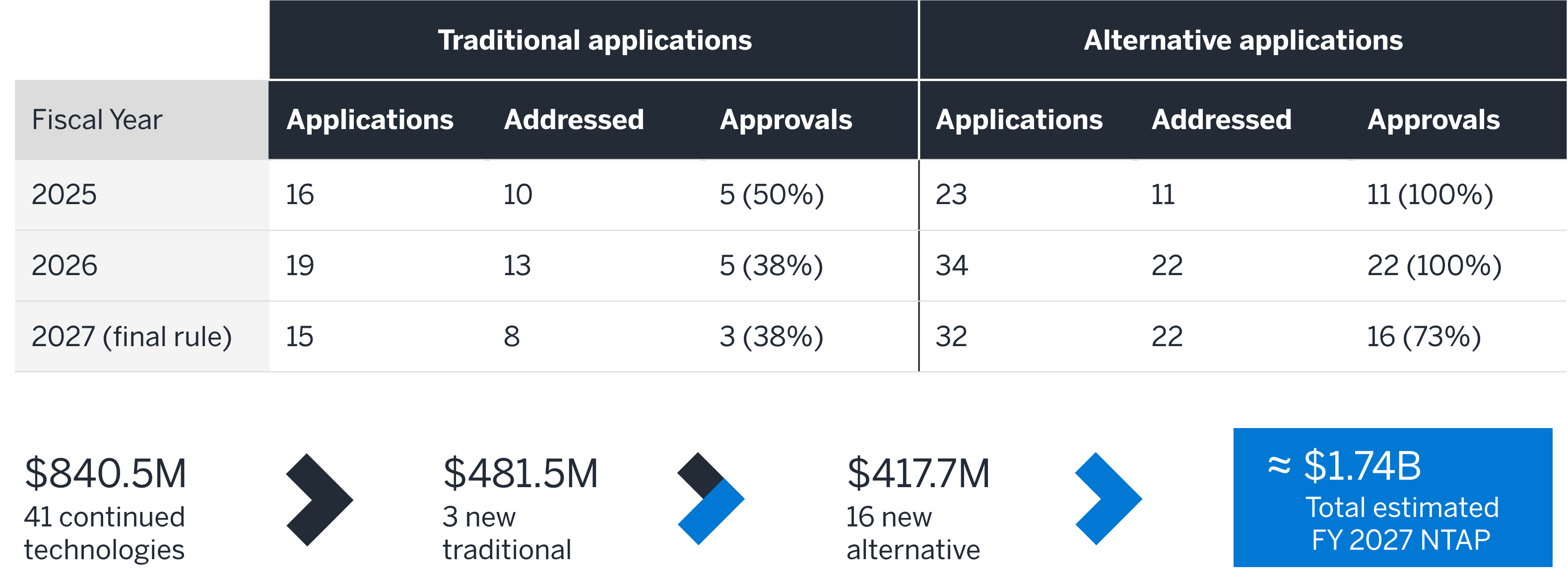
* “Applications” counts all submissions; “Addressed” excludes applications that did not meet FDA authorization requirements or were withdrawn before the rule.
FDA marketing authorization
Applicants must have a complete and active FDA market authorization request at the time of the NTAP application submission and must provide documentation of FDA acceptance or filing to CMS at the time of application submission. Each year, several applications are submitted without meeting this requirement, which makes them ineligible for review. These account for the change from “Applications” to “Addressed” in Figure 5. It is critical for life science companies to confirm their FDA market authorization by May 1 prior to the fiscal year for which the application is being considered. For a FY 2028 application, this means acquiring FDA marketing authorization by May 1, 2027.15 However, given the significant lead time for submitting an application, life science companies should engage in NTAP planning in parallel with late-stage FDA regulatory submissions, not sequentially. Waiting for FDA authorization before beginning the NTAP application process may result in missing a cycle entirely.
SCI stringency
For technologies that make it to CMS review, most of those that do not receive approval are denied for not meeting CMS’s SCI threshold. A few common themes for products not meeting the SCI criteria are listed below:
- FDA approval is not the same as improvement of existing treatments.16 CMS states that safety/efficacy is not the same as improvement over existing treatments. After the FDA approves a new technology, CMS may not consider it to be meaningfully different from other treatments without additional evidence.
- First-in-class is not enough.17 CMS has denied applications for products that are the first treatment with a narrower indication, stating that the narrower indication does not explicitly demonstrate clinical improvement and other treatments with broader indications remain available.
- Trial populations are not meaningful.18 CMS does not set a fixed trial size, but applications have been denied due to the reference populations being too small or not generalizable to a Medicare population.
Does the NTAP pathway make sense for my technology?
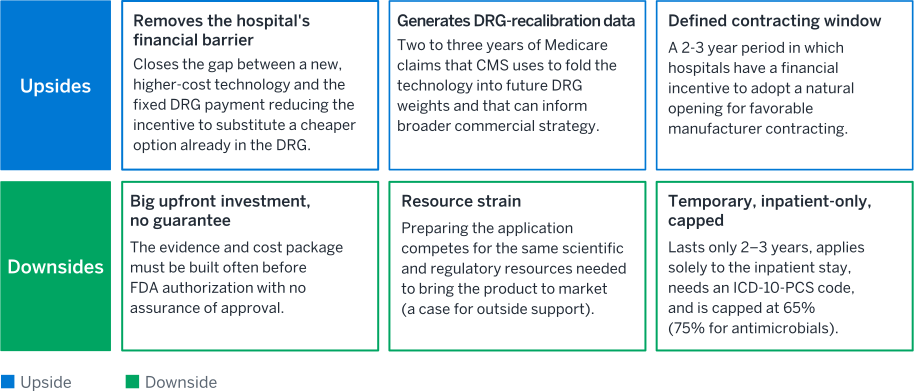
As the prior section suggests, receiving approval for an NTAP requires significant planning and resources to meet all required CMS criteria. Products that are approved benefit from significant upsides that make the process worthwhile. Figure 6 below displays the potential upsides and downsides of the NTAP process.
Figure 6: NTAP upsides and downsides
How can Milliman help?
Successfully navigating the NTAP application process requires significant planning and support. Milliman’s actuarial and clinical expertise, our robust data assets,19 and experience with CMS evidentiary standards allow us to support life sciences organizations across the full NTAP lifecycle. From cost criterion analysis through post-approval monitoring, Milliman can help life science companies build credible, well-documented applications that align with CMS's decision-making patterns.
- Cost criterion analysis
Milliman provides independent, third-party cost analyses that meet all CMS requirements. This includes identifying the relevant MS-DRGs, estimating mean charges and standard deviations using proprietary and public data sources, modeling the technology's incremental cost impact, and validating assumptions against CMS's published Cost-to-Charge (CCR) thresholds. Sensitivity analyses across varying adoption rates, and case mix demonstrate that the cost criterion is met under realistic conditions. - SCI support
Although SCI is ultimately a clinical and regulatory hurdle, Milliman's data assets and analytical capabilities can provide supporting evidence that strengthens the applicant's case, particularly in areas where CMS has flagged deficiencies in prior denials. Examples of SCI support include: - Medicare population characterization: Quantifying the demographics, comorbidities, and treatment history of the Medicare-eligible target population
- Treatment landscape and unmet need: Documenting current standard-of-care patterns and identifying patient subgroups with no coded treatment, failed therapies, or repeated hospitalizations
- Outcomes benchmarking: Establishing baseline mortality, readmission, complication, and line of service metrics under current care, providing the "before" against which clinical improvement is measured
- Understanding the patient journey
NTAPs, by definition, only address care for Medicare FFS beneficiaries that occurs in the inpatient setting. However, understanding the impact of new technologies outside of the inpatient setting and across markets is critical for all stakeholders. Milliman’s data assets are able to provide a longitudinal view across all sites of care, tracking costs before and after treatment and providing support for pre-application feasibility through post-approval monitoring. - Hospital negotiation and contracting support
Milliman can support life science companies in developing hospital contracting strategies that maximize new technology adoption during the NTAP window. Using internal data assets and actuarial modeling capabilities, Milliman quantifies the financial dynamics hospitals face when evaluating a new technology. This includes assessing the gap between the technology's cost and the DRG payment, the portion closed by NTAP, and any residual cost the hospital absorbs. Milliman works with life science companies to identify the price point at which the NTAP offset makes adoption financially viable. By benchmarking the technology's cost profile against comparable technologies and quantifying the clinical and economic value proposition in terms hospitals use internally, Milliman helps life science companies anticipate decision criteria used by hospital stakeholders, such as the Pharmacy & Therapeutics (P&T) and Value Analysis committees. This hospital-facing analytical support complements the clinical evidence and helps translate the NTAP approval into actual adoption and utilization.
Conclusion
The NTAP program remains a key lever for life sciences and medical device organizations to market new treatments and technologies, but the program is entering a period of significant transition. The FY 2027 final rule's repeal of the alternative pathway, effective for FY 2028 applications, will require all applicants to meet the full evidentiary standard that has led to declining traditional pathway approval rates over the past several years. At the same time, the program's fiscal footprint continues to grow. These dynamics signal both heightened CMS scrutiny and sustained demand for seeking supplemental payments in order to provide hospitals with additional reimbursement for innovative technologies.
Given the increasingly stringent level of documentation required for NTAP approval, it is critical for life sciences organizations to plan ahead by gathering the right level of support for a competitive NTAP application. It is also important to plan for product life cycles beyond the NTAP eligibility window. Milliman's actuarial and clinical expertise, robust data assets, and experience with CMS submissions are well-positioned to support stakeholders across the NTAP lifecycle and beyond.
1 Compilation of the Social Security Laws. (n.d.) Social Security Administration. Retrieved August 15, 2026, from https://www.ssa.gov/OP_Home/ssact/title18/1886.htm.
2 Centers for Medicare & Medicaid Services. (2026, August 4). Medicare program: Hospital inpatient prospective payment systems for acute care hospitals (IPPS) and the long-term care hospital prospective payment system and policy changes and fiscal year (FY) 2027 rates; requirements for quality programs; other policy changes; and adoption of updated versions of certain health information technology standards. 91 Fed. Reg. 49570. Retrieved August 15, 2026, from https://www.govinfo.gov/content/pkg/FR-2026-08-04/pdf/2026-15833.pdf.
3 New medical services and new technologies. (2026, August 11). Centers for Medicare & Medicaid Services. Retrieved August 15, 2026, from https://www.cms.gov/medicare/payment/prospective-payment-systems/acute-inpatient-pps/new-medical-services-and-new-technologies.
4 Centers for Medicare & Medicaid Services. (2019, August 16). Medicare program; hospital Inpatient Prospective Payment Systems for acute care hospitals and the long-term care hospital prospective payment system and policy changes and fiscal year 2020 rates; quality reporting requirements for specific providers; Medicare and Medicaid promoting interoperability programs requirements for eligible hospitals and critical access hospitals. 84 Fed. Reg. 42044. Retrieved August 15, 2026, from https://www.federalregister.gov/citation/84-FR-42044.
5 Centers for Medicare & Medicaid Services. (2024, October 10). Medicare and Medicaid programs and the Children’s Health Insurance program; hospital inpatient prospective payments systems for acute care hospitals and the long-term care hospital prospective payment system and policy changes and fiscal year 2025 rates; quality programs requirements; and other policy changes; correction. 89 Fed. Reg. 80098. Retrieved August 15, from https://www.federalregister.gov/documents/2024/10/02/2024-22501/medicare-and-medicaid-programs-and-the-childrens-health-insurance-program-hospital-inpatient.
6 Centers for Medicare & Medicaid Services. (2025, August 4). Medicare program; hospital Inpatient Prospective Payment Systems for acute care hospitals (IPPS) and the long-term care hospital prospective payment system and policy changes and fiscal year (FY) 2026 rates; changes to the FY 2025 IPPS rates due to court decision; requirements for quality programs; and other policy changes; health data, technology, interoperability: Electronic prescribing, real-time prescription benefit and electronic prior authorization. 90 Fed. Reg. 36536. Retrieved August 15, 2026, from https://www.federalregister.gov/documents/2025/08/04/2025-14681/medicare-program-hospital-inpatient-prospective-payment-systems-for-acute-care-hospitals-ipps-and.
7 Centers for Medicare & Medicaid Services. (2026, April 14). Medicare program; hospital Inpatient Prospective Payment Systems for acute care hospitals (IPPS) and the long-term care hospital prospective payment system and policy changes and fiscal year (FY) 2027 rates; requirements for quality programs; and other policy changes. 91 Fed. Reg. 19312. Retrieved August 15, 2026, from https://www.federalregister.gov/documents/2026/04/14/2026-07203/medicare-program-hospital-inpatient-prospective-payment-systems-for-acute-care-hospitals-ipps-and.
8 Centers for Medicare & Medicaid Services. Medicare program; hospital Inpatient Prospective Payment Systems for acute care hospitals (IPPS) and the long-term care hospital prospective payment systems and policy changes for fiscal year (FY) 2027 rates; requirements for quality programs; other policy changes; and adoption of updated versions of certain health information technology standards. 91 Fed. Reg. 49682. Retrieved August 15, 2026, from CMS, FY 2027 IPPS/LTCH PPS final rule, 91 Fed. Reg. 49570, 49679–49682 (Aug. 4, 2026).
9 Code of Federal Regulations. (2026, August 13). Title 42., Chapter IV, Subchapter B, Part 412, Subpart F, Additional special payment for new technology, Section 412.88. Retrieved August 15, 2026, from https://www.ecfr.gov/current/title-42/section-412.88.
10 Code of Federal Regulations. (2026, August 13). Title 42., Chapter IV, Subchapter B, Part 412, Subpart F, Additional special payment for certain new technology, Section 412.87. Retrieved August 15, 2026, from https://www.ecfr.gov/current/title-42/chapter-IV/subchapter-B/part-412/subpart-F/subject-group-ECFR5703923263fedba/section-412.87.
11 Centers for Medicare & Medicaid Services. (2024, August 28). Medicare and Medicaid programs and the Children’s Health Insurance program; hospital Inpatient Prospective Payment Systems for acute care hospitals and the long-term care hospital prospective payment system and policy changes and fiscal year 2025 rates; quality programs requirements; and other policy changes. 89 Fed. Reg. 69121. Retrieved August 15, 2026, from https://www.federalregister.gov/documents/2024/08/28/2024-17021/medicare-and-medicaid-programs-and-the-childrens-health-insurance-program-hospital-inpatient#page-69121.
12 Centers for Medicare & Medicaid Services. (2019, August 16). Medicare program; hospital Inpatient Prospective Payment Systems for acute care hospitals and the long-term care hospital prospective payment system and policy changes and fiscal year 2020 rates; quality reporting requirements for specific providers; Medicare and Medicaid promoting interoperability programs requirements for eligible hospitals and critical access hospitals. 84 Fed. Reg. 42044. Retrieved August 15, 2026, from https://www.federalregister.gov/citation/84-FR-42044.
13 Centers for Medicare & Medicaid Services. (2024, October 10). Medicare and Medicaid programs and the Children’s Health Insurance program; hospital inpatient prospective payments systems for acute care hospitals and the long-term care hospital prospective payment system and policy changes and fiscal year 2025 rates; quality programs requirements; and other policy changes; correction. 89 Fed. Reg. 80098. Retrieved August 15, from https://www.federalregister.gov/documents/2024/10/02/2024-22501/medicare-and-medicaid-programs-and-the-childrens-health-insurance-program-hospital-inpatient.
14 Centers for Medicare & Medicaid Services. (2025, August 4). Medicare program; hospital Inpatient Prospective Payment Systems for acute care hospitals (IPPS) and the long-term care hospital prospective payment system and policy changes and fiscal year (FY) 2026 rates; changes to the FY 2025 IPPS rates due to court decision; requirements for quality programs; and other policy changes; health data, technology, interoperability: Electronic prescribing, real-time prescription benefit and electronic prior authorization. 90 Fed. Reg. 36536. Retrieved August 15, 2026, from https://www.federalregister.gov/documents/2025/08/04/2025-14681/medicare-program-hospital-inpatient-prospective-payment-systems-for-acute-care-hospitals-ipps-and.
15 Centers for Medicare & Medicaid Services. (2026, April 14). Medicare program; hospital inpatient prospective payments systems for acute care hospitals (IPPS) and the long-term care hospital prospective payment system and policy changes and fiscal year (FY) 2027 rates; requirements for quality programs; and other policy changes. 91 Fed. Reg. 19312. https://www.federalregister.gov/documents/2026/04/14/2026-07203/medicare-program-hospital-inpatient-prospective-payment-systems-for-acute-care-hospitals-ipps-and.
16 Centers for Medicare & Medicaid Services. (2024, August 28). Medicare and Medicaid programs and the Children’s Health Insurance program; hospital inpatient prospective payments systems for acute care hospitals and the long-term care hospital prospective payments system and policy changes and fiscal year 2025 rates; quality programs requirements; and other policy changes. 89 Fed. Reg. 69080. Retrieved August 15, 2026, from https://www.federalregister.gov/citation/89-FR-69080.
17 Centers for Medicare & Medicaid Services. (2025, August 4). Medicare program; hospital inpatient prospective payments systems for acute care hospitals (IPPS) and the long-term care hospital prospective payment system and policy changes and fiscal year (FY) 2026 rates; changes to the FY 2025 IPPS rates due to court decision; requirements for quality programs; and other policy changes; health data, technology, and interoperability: Electronic prescribing, real-time prescription benefit and electronic prior authorization. 90 Fed. Reg. 36884. Retrieved August 15, 2026, from https://www.federalregister.gov/citation/90-FR-36884.
18 Centers for Medicare & Medicaid Services. (2024, August 28). Medicare and Medicaid programs and the Children’s Health Insurance program; hospital Inpatient Prospective Payment Systems for acute care hospitals and the long-term care hospital prospective payment system and policy changes and fiscal year 2025 rates; quality programs requirements; and other policy changes. 89 Fed. Reg. 69121. Retrieved August 15, 2026, from https://www.federalregister.gov/citation/89-FR-69121.
19 https://us.milliman.com/en/health/life-sciences/data-assets.