Many manufacturers and retailers (“issuers”) use warranty programs to enhance customer loyalty, generate additional revenue, and differentiate themselves in competitive markets. Offering these products requires a solid understanding of the expected cost of claims over the warranty period.
What is an OEM warranty vs. an extended warranty?
An OEM (original equipment manufacturer) warranties are common and typically built into the price of the goods sold. Extended warranties provide customers protection beyond the standard manufacturer’s guaranteed term for an additional fee. Both types of warranties typically cover repairs or replacements for a specified period of time, often in years.
Why are accurate warranty cost estimates important?
Poor warranty management—such as mispricing warranties or misestimating claim costs—can cause financial losses from underestimated claims or lost sales from overpriced options. Moreover, it may take many years after the first warranty is issued for costs to emerge, due to long coverage periods. As a result, it’s crucial for finance and risk managers to accurately estimate claim reporting lag and the reserves needed for latent claims.
One of the best ways to combat the inherent risk of warranty programs is to collect clean, comprehensive data. Robust actuarial models rely on this data to evaluate both the exposure to risk and the actual claims experience.
The earlier a company begins capturing the right information, the better. Starting warranty data collection early allows for historical analysis, trend identification, and more informed pricing strategies. This article outlines key data elements essential for this process and explains why each is vital.
What OEM warranty exposure data should be collected?
The foundation of any warranty cost estimation is an exposure base, which quantifies the covered population of products. The most common and useful bases are:
- Number of units sold: Tracking the number of units sold provides a direct measure of how many products are in the market and may generate claims under an OEM’s warranty. Without this, actuaries cannot normalize claim frequency (scaling projections based on business volume). If individual sales are not available, aggregated data by month is acceptable.
- Sales revenue: Sales revenue adds financial granularity because higher-priced items often incur proportionally higher claim costs. For example, a $200 blender and a $2,000 smart refrigerator carry very different repair or replacement costs. Capturing revenue (or average selling price) allows actuaries to develop severity models that scale with item value, improving loss cost estimates and better segmentation of pricing tiers.
What extended warranty exposure data should be collected?
- Number of extended warranty contracts sold and premium collected: Contract counts and premium are the gold-standard exposure measures for extended warranties. They reveal the subset of total products covered under extended warranty, which is essential for estimating true exposure (as claims can only arise from contracted items). Without these metrics, cost estimates may be overstated (by assuming universal coverage) or understated (if adoption is higher than expected). Premium data also supports forecasting program profitability and monitoring uptake rates over time.
What warranty dates should issuers collect?
There are two important dates to record for claim activity—the sale date of the underlying product and the date the warranty claim is reported—plus one additional date that is optional but helpful to have.
- Sale date (or warranty effective date): Recording the sale date establishes the inception point for the coverage period. It defines when the warranty clock starts and is essential for measuring product age at the time of claim. It also helps confirm claims are reported within the coverage window.
- Claim date (reported date): The date a customer reports a failure is indispensable for understanding incident timing and frequency. Actuaries use sale date and claim date in tandem to model claim lag patterns. This information directly influences reserve setting, revenue recognition, and pricing adjustments for future offerings.
- Claim payment date (optional but valuable): The date the claim is paid can be a helpful reserving metric, especially when there is significant delay between claim reporting and payment.
Figures 1–3 illustrate claim reporting lag patterns observed across the warranty industry. The figures display the percentage of claims reported by year for the first five years after the product is sold. The variations are attributable to factors such as product quality controls, expected product longevity, and service or channel practices.
Collectively, these figures demonstrate that there is no universally applicable warranty lag profile. Issuers should calibrate assumptions to their own products rather than rely on industrywide patterns.
Figures 1–3
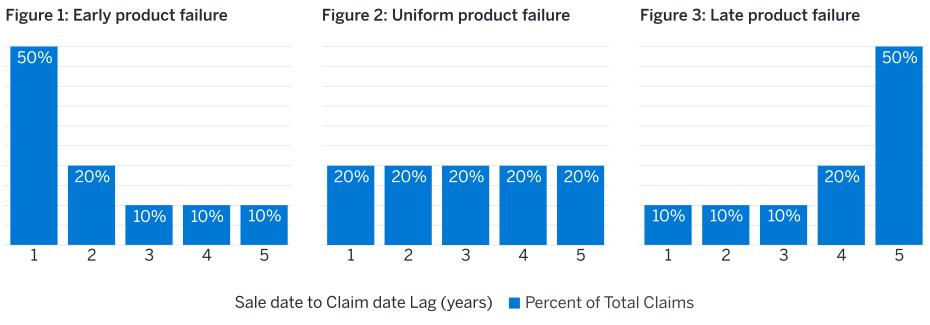
Understanding the claim lag patterns (sometimes referred to as “earnings patterns” in warranty reserving) helps issuers select warranty term length. For example, Figure 1’s claim lag pattern indicates higher costs early in the warranty period, which makes an extended warranty an attractive offering.
In contrast, a lag pattern like Figure 3 may appear favorable early in a product’s life and tempt an issuer to extend the term or lower assumed warranty costs (even though most claims materialize in years four and five). Without accurate sale and claim dates, issuers can misestimate the emergence pattern and make adverse financial decisions that may take years for the consequences to surface.
How can additional data granularity improve warranty modeling?
A crucial step in warranty cost estimation is segmentation and root cause analysis. Collect the following characteristics to refine your models:
- Parts costs vs. labor costs: Separating parts and labor costs enables independent review of underlying trends by cost component. It improves how you understand, forecast, and manage warranty risk. Parts and labor are driven by different economic forces and operational realities, so combining them into a single “total repair cost” can mask underlying trends.
- Product type/model details: Different models may have varying failure rates due to design, materials, or usage patterns. This data is vital for segmentation in actuarial models, allowing for product-specific modeling rather than a one-size-fits-all approach. It helps identify high-risk items that might require higher pricing or exclusions, ensuring that cost estimates reflect real-world performance and prevent cross-subsidization across your product lineup.
- Customer demographics: Variables such as age groups, locations, sales channel (e.g., online versus in-store), or usage profiles provide insights into risk factors. Without it, estimates might overlook demographic-driven trends, leading to broad assumptions that don’t capture nuanced cost drivers. For example, products used in harsh climates might fail more often. Plus, capturing these fields can generate valuable customer insights for marketing.
- Reason for failure: Capturing failure reason (e.g., mechanical breakdown, accidental damage, software issues) supports root cause analysis and trend detection, such as recurring defects in specific components. It also helps actuaries refine projections by removing outliers and reflecting mitigation actions (e.g., product improvements).
How are exposure and claims datasets integrated?
Exposures and claim data are almost always maintained separately; however, they need to communicate with one another. Best practice is utilizing unique identifiers to link the customer across both exposure and claims databases. This unlocks the ability to analyze warranty data by customer demographics, product type, sale date, premium, and contract terms (all recorded in the exposure database), as well as claim date, reason for failure, and claim costs (all recorded in the claims database).
What does it all mean?
Finance executives who proactively collect these data elements can manage OEM warranty programs and evaluate the feasibility of extended warranty offerings with greater confidence and data-driven insight. By building a clean, connected warranty dataset that captures a clear exposure base, critical claim timing fields, and segmentation variables, manufacturers and retailers alike can materially reduce pricing and reserving uncertainty.
Ultimately, collecting these elements early supports more accurate cost projections, better financial decisions, and a warranty program that is both profitable and customer-friendly. Actuarial analysis supported by early data aggregation not only facilitates precise cost modeling but can also uncover opportunities for risk mitigation and revenue optimization.