The Inflation Reduction Act of 2022 (IRA) implemented extensive changes to the Medicare program intended to reduce beneficiary costs, including the Medicare Drug Price Negotiation Program (MDPNP).1 This program authorized the Secretary of Health and Human Services to establish maximum fair prices (MFPs) for selected qualifying single-source drugs and biologics in Medicare Part D and, beginning in 2028, Medicare Part B. The expansion of the MDPNP into Part B introduces a new set of operational complexities and financial considerations. In this paper, we provide an overview of key concepts for stakeholders to understand related to these new Part B dynamics.
Overview of the MDPNP
What is the selection process under MDPNP?
Drugs are selected annually for the MDPNP, and MFPs are established following selection. The first year the drug is selected is the initial price applicability year (IPAY). MFPs for the first cohort of 10 drugs (IPAY 2026) took effect January 1, 2026,2 with 15 additional drugs selected in each of IPAYs 20273 and 2028.4
What are maximum fair prices under MDPNP?
MFPs reflect average list price discounts of approximately 60% for IPAYs 2026 and 2027, based on discounts published by CMS. IPAY 2028 discounts are not yet known at the time of writing but will be released no later than November 30, 2026. Net savings to plans are lower after accounting for eliminated rebates and Manufacturer Discount Program (MDP) payments5 for Part D drugs, though realized savings on the Part B benefit are likely to be higher due to lower rebates and no MDP. Once a drug has been selected, the MFP is effective until a generic or biosimilar alternative for that product has been marketed for at least nine months.
What’s new for Part B selections?
The IPAY 2028 drugs primarily covered under the Part B benefit include Botox, Cimzia, Entyvio, Orencia, and Xolair. Part D drugs are typically self-administered products purchased by the patient at a retail pharmacy, whereas Part B drugs are typically administered by a healthcare professional in a hospital or office setting. Following the expansion of MDPNP to Part B products in 2028, IPAY 2029 will include a greater number of selected drugs (up to 20 Part B and D drugs), of which high-spend drugs Opdivo and Keytruda are likely candidates for selection.6
Some unique aspects of Part B products will create new dynamics that did not previously exist when selections were limited to Part D products in IPAYs 2026 and 2027.
- Claims Processing: Unlike Part D, where claims are processed almost instantly at the pharmacy counter, Part B claims are typically subject to lagged processing and adjudication. The timing creates additional complexities beyond those encountered in Part D, as providers must be reimbursed for the lower MFP price under the same prompt payment window as Part D claims once the Part B claim-level elements are received by the manufacturer.
- Reimbursement: Part D drugs are typically purchased at a discount off the Average Wholesale Price, which is set by the manufacturer. Part B drugs are typically purchased at a value near Average Sales Price (ASP), which is determined as the average price paid across all purchasers. Providers are reimbursed for Part B drugs at ASP plus a 6% add-on before sequestration.
Beginning in 2028, manufacturers of selected Part B drugs must provide access to MFPs by either proactively ensuring that the acquisition cost is no greater than the MFP or by retrospectively reimbursing the difference between the acquisition cost and the MFP through a Standardized Default Refund Amount (SDRA)7 within 14 days of receiving information about the claim from the Medicare Transaction Facilitator (MTF). The two dynamics above create significant complexity surrounding the effectuation of the SDRA. Guidance about how the SDRA will be calculated for Part B has yet to be finalized, with draft guidance suggesting calculating SDRA as the difference between MFP and either ASP or Wholesale Acquisition Cost (WAC).
The following example SDRA calculations show the implications of these different reimbursement methodologies for an illustrative drug with a WAC of $12,000, an ASP (prior to MDPNP) of $10,000 (i.e., assuming a 20% supplier concession), and an MFP of $6,000. For simplicity, we assume only one NDC is using the relevant HCPCS (CMS has proposed two different volume weighting methods as well). This illustration assumes the provider purchases at ASP and ignores other manufacturer costs (e.g., research and development, administrative expenses, fees) outside of this specific drug claim.
Figure 1: Stakeholder cash flows for an illustrative drug under SDRA proposals – $12,000 WAC, $10,000 ASP, $6,000 MFP
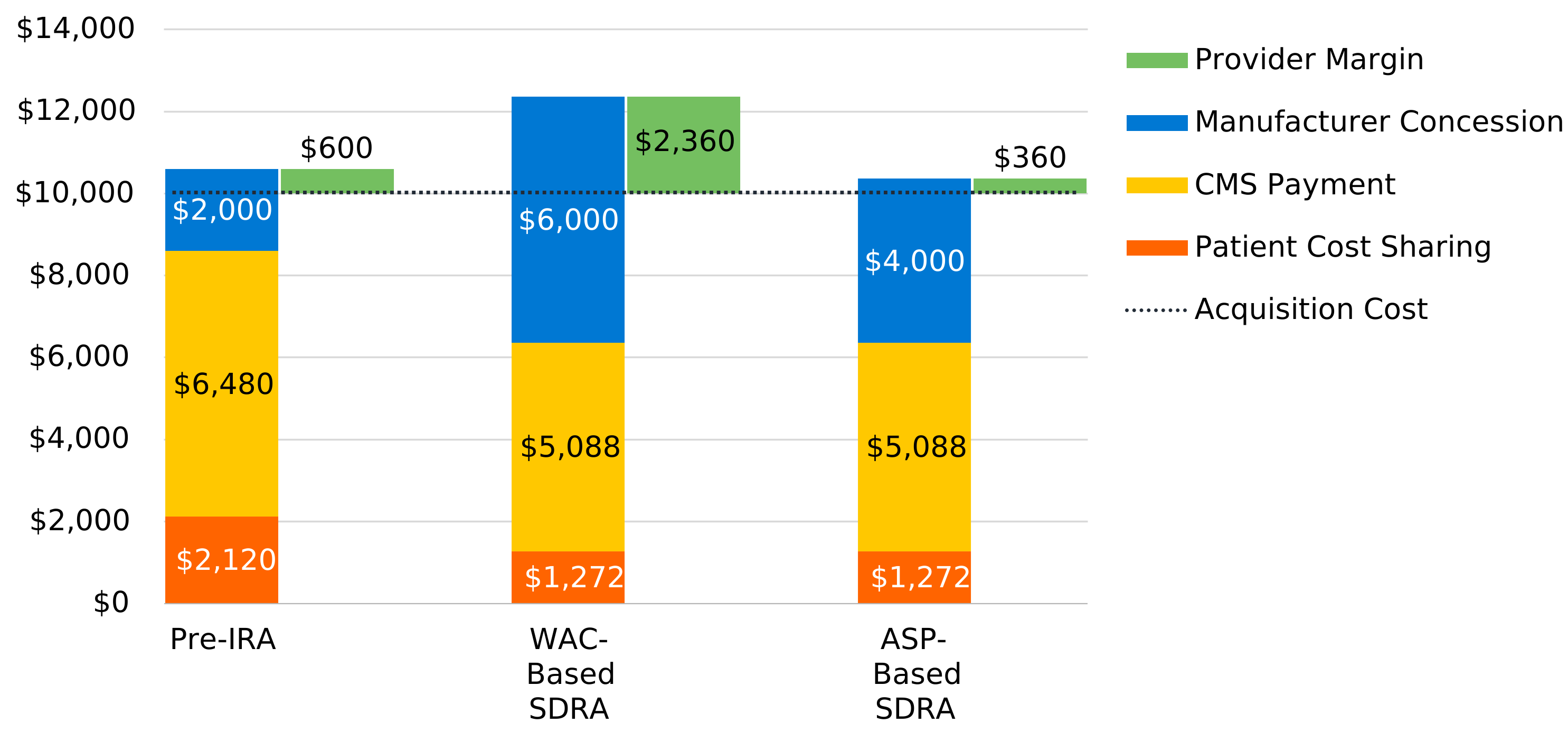
Unlike Part D, in Part B the acquisition cost is often not close to the WAC; it is typically meaningfully lower. For this reason, the SDRA under a WAC-based metric would lead to higher margins for hospitals and higher costs for manufacturers. Current ASP levels provide a more accurate proxy for actual drug acquisition costs, but there is a significant challenge: MFP is included in the calculation of ASP, which means ASP will fall over time as MFP is incorporated into the average. This will likely result in ASP diverging from true average acquisition costs and could cause the provider margin to become negative for selected drugs. Further, CMS has indicated that it will not publish the ASP for negotiated drugs, making it challenging to use as a calculation metric.
MDPNP impacts by healthcare stakeholder
These changes will have financial implications for nearly every Medicare stakeholder starting in 2028, including healthcare providers and Medicare Fee-for-Service (FFS) beneficiaries, who have previously not been impacted by the MDPNP.
How MDPNP could impact providers
- Potentially reduced margins: Under the MDPNP, providers would no longer receive reimbursement at ASP plus the 6% add-on payment, but rather MFP plus the 6% add-on payment. If providers are paid for the exact difference between their acquisition cost and MFP, this would result in reduced margins for providers administering these products, equal to the difference between 6% of ASP and 6% of MFP. However, a provider’s actual change in margin is highly dependent on which SDRA methodology is ultimately selected, as shown above.
- Commercial spillover: Changes to ASP create downstream impacts on the commercial market. Many commercial contracts are set at a percentage of the Medicare reimbursement rate or of ASP itself. With ASP no longer published for these products, many providers may have to renegotiate their commercial contracts.
- 340B impacts: Hospitals with 340B status are likely to see materially reduced margins. These providers acquire drugs at the 340B ceiling price, which may already be at or below MFP, but they are currently reimbursed at the standard ASP+6%. As a result, 340B hospitals have a much wider margin on Part B drugs than non-340B hospitals today, and thus have more to lose when reimbursement drops to MFP+6%. It is important to note that the 2027 proposed OPPS rule calls for reducing 340B reimbursement on all Part B drugs to ASP-33.4%,8which would reduce 340B margin on all drugs and thus mitigate the incremental impact of MFPs for selected drugs.
A 340B rebate pilot has been introduced for Part D selected drugs in 2027,9 and the pilot could potentially be applied to Part B as well to prevent duplicate discounts. That said, duplicate discounts may be easier to prevent in Part B, since essentially all of a given hospital’s claims will be 340B-eligible or not, compared to Part D, where a contract pharmacy fills both 340B and non-340B claims.
- Administrative burden: The MDPNP is likely to increase the administrative burden on providers. Additional tracking will be required since claims administration and manufacturer reimbursement will be separate from other Part B products. Selected drugs may require a separate inventory system, since providers do not know in advance if the product will be used for a Medicare patient (where the MFP applies) or a commercial or other patient (where the MFP does not apply). These distinctions between patients in different markets and selected versus not selected Part B products have implications for provider cash flows and risk-sharing arrangements.
Due to these headwinds, providers may be less able to stock selected Part B products. When clinically appropriate alternatives for the selected products are available, prescribing patterns may shift to favor those alternate products. Administration for selected products may shift from physician offices to clinics, which are better-equipped financially to deliver these services. However, providers in capitated risk-sharing arrangements may have more incentive to use selected products due to their lower cost, assuming the capitation rate is not reduced to account for MFP pricing.
How MDPNP could impact patients
- Cost Sharing: Patient cost sharing for Part B drugs, which is typically 20% coinsurance, will be based on MFP rather than ASP for selected drugs. As such, average cost sharing is likely to decrease with the implementation of MFPs since coinsurance will be applied to a lower drug cost. However, most beneficiaries are enrolled in plans that provide supplemental coverage,10 such as $0 cost sharing or a maximum out-of-pocket (MOOP) limit, such that cost sharing may not change. Patient impacts will vary depending on market segment.
- FFS: Patients are responsible for a Part B deductible followed by 20% coinsurance with no limit. This means patients without supplemental coverage will pay less under MDPNP since they will pay 20% of the MFP cost compared to 20% of the historical cost. However, only 3% of Medicare beneficiaries have no supplemental coverage.11 FFS beneficiaries also enrolled in Medicaid or Medigap typically have $0 or nominal cost sharing and thus are not directly impacted by MDPNP.
- Medicare Advantage: Patients are typically responsible for 20% coinsurance until they reach the plan MOOP. Some patients will see reduced cost sharing as a result of the MFP cost, though patients who reach their MOOP with the MDPNP in place will likely not realize annual savings with the implementation of MFPs for Part B products (though cost sharing for early individual fills may be reduced). MFPs for Part B drugs selected for MDPNP are likely to be sufficiently high cost that many patients may still reach MOOP.
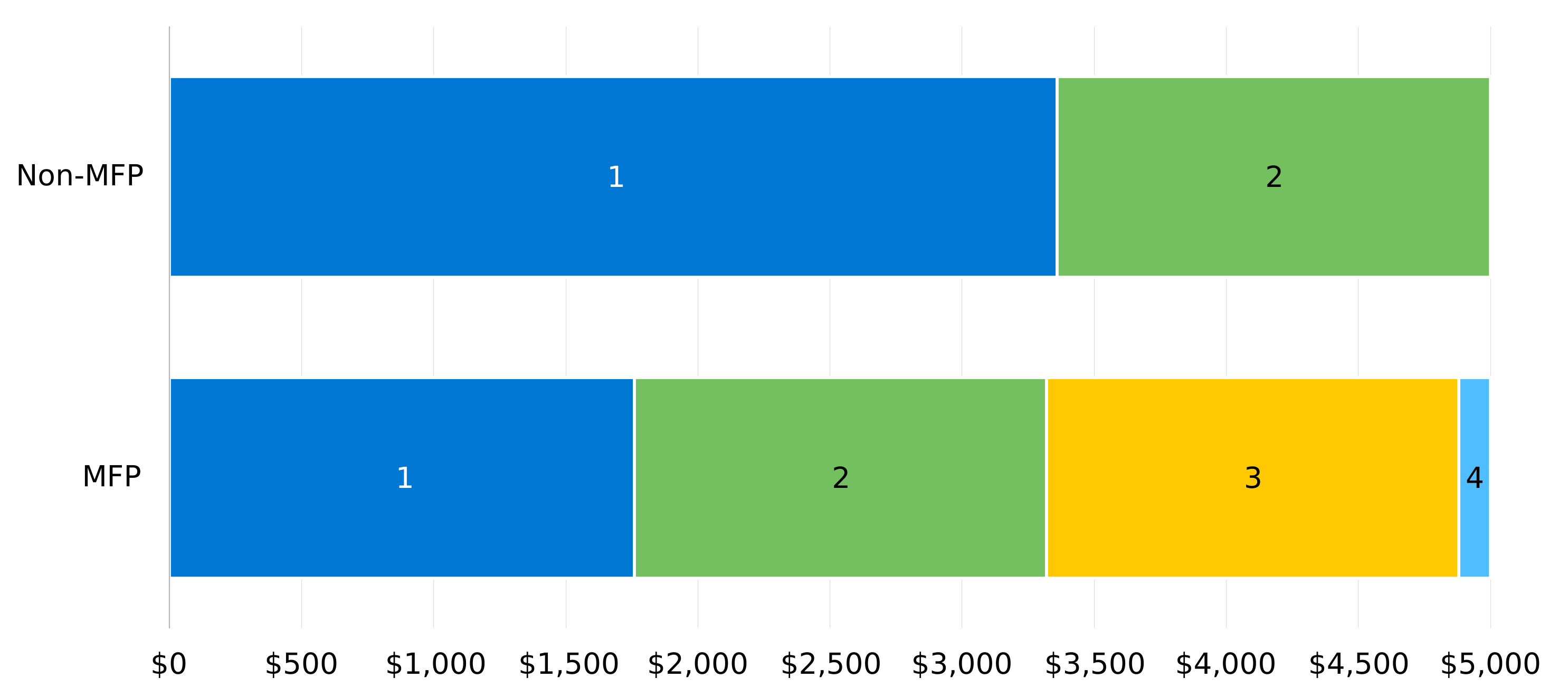
Figure 2 compares annual cost sharing for a beneficiary who takes a selected Part B product with a monthly cost of $16,000 and is enrolled in a plan with a $200 deductible, 20% coinsurance, and a MOOP of $5,000. We assume this beneficiary has no other spend.
- Without the MDPNP in place, this beneficiary reaches MOOP with the second script, and therefore pays nothing for the remaining scripts.
- With an MFP of $8,000, this beneficiary reaches their MOOP with the fourth script. As long as the MFP is above $2,000, this beneficiary would still reach the annual MOOP and spend the same total amount as without MDPNP. Therefore, the MDPNP may not have a meaningful impact for patients who currently reach their MOOP unless the discount is large enough to reduce cost sharing to below the MOOP.
Figure 2: Member cost sharing by script for an illustrative drug – $16,000 WAC, $8,000 MFP, $200 deductible, 20% coinsurance, $5,000 MOOP
- Member Premiums: The reduction in overall Part B costs attributable to MDPNP may result in lower Part B premiums paid by all members. Medigap premiums may decrease for the same reason. For Medicare Advantage members, the reduction in overall Part B costs as a result of MDPNP is likely to drive a similar reduction in benchmark payment rates from CMS, thereby resulting in minimal impact on Medicare Advantage premiums, which are paid in addition to the Part B premium.
- Access: Patients may find it harder to access selected drugs in situations where providers opt to reduce or eliminate their inventory of those products due to the reimbursement challenges described earlier. Commercial patients may also be impacted if this occurs. Although some patients may find it harder to access selected drugs, patients who see decreases in cost sharing (particularly FFS beneficiaries without supplemental coverage) may be incentivized to use these products more. Similarly, Medicare Advantage plans and capitated providers will be incentivized by the lower costs and may steer patients toward selected drugs through step therapies.
How MDPNP could impact manufacturers
- Decreased revenue: Manufacturer revenue is expected to decrease as a result of the discount for selected products. The magnitude of this decrease will depend on the relationship between MFP and existing price concessions. Further, the revenue loss could be greater depending on which SDRA is selected for effectuation.
- R&D: MFPs on Part B products are likely to create meaningful losses of revenue on Part B products, where price concessions are typically lower than on Part D products, creating a larger differential between the MFP and current net price. This decrease in margin could be compounded if providers reduce utilization of selected drugs.
- Commercial spillover: Although rebates on Part B products are typically low, the introduction of MFP discounts in Medicare may cause payers to push for similar discounts in the commercial market. This would increase pressure on manufacturer margins.
These factors may cause manufacturers to revise pricing strategies for selected products and pipeline products that may be selected in the future. For example, Imbruvica’s manufacturer announced a reduction in WAC that mirrored its MFP effective December 2025, shortly before the effective date of the MFP in January 2026.12 If the SDRA is tied to WAC, manufacturers may lower their WAC to reduce their price concessions on MFP scripts as illustrated in Figure 1; however, they will need to evaluate the impact of this strategy across all lines of business.
How MDPNP could impact health plans
- Neutral cost impact: All else equal, MFPs for Part B products may result in savings for some Medicare Advantage plans, though we expect that the reduction in Part B drug costs will be offset by reduced premiums, especially for Medicare Supplement plans, benchmark, and rebate payments.
- Formulary coverage: Given that MFPs will generate lower prices and rebate tradeoffs are less relevant in Part B, Medicare Advantage plans may require patients to step through selected drugs before trying a higher-cost alternative.
- Potential utilization changes: The likelihood of savings could be reduced if providers shift prescribing patterns to more costly drugs with higher margins or if patients increase use of selected drugs due to actual or perceived cost sharing savings.
- Risk adjustment: To the extent that the risk adjustment model is not adjusted to reflect the new MFP of these drugs, plans could be overcompensated for costs incurred for these products temporarily until the data used to calibrate the model reflects MFPs. Because risk scores are calibrated to a 1.0 basis, this means plans would be undercompensated for beneficiaries with other conditions not affected by MFPs.
- Commercial impacts: Commercial health plans will likely have to renegotiate contracts for selected products if their contracts are set as a percentage of Medicare or a percentage of ASP, which will no longer be published.
How MDPNP could impact the government
- Reduced expenditures: With the implementation of MFPs for Part B products in 2028, overall costs for Part B drugs are expected to decrease thereby reducing FFS costs. This includes a reduction in the government liability for Medicare claim costs as well as a reduction in Medicaid costs for dual-eligible beneficiaries using selected drugs and a commensurate decrease in benchmark payments to Medicare Advantage plans.
- Operations: The federal government will have expanded operational oversight and be required to make additional considerations as Congress writes legislation related to the MDPNP with the inclusion of Part B products.
Government expenditures are largely expected to decrease as a result of the inclusion of Part B products under the MDPNP. Although CMS has not yet announced intentions to update the MA risk adjustment model to incorporate the updated cost of these products, the agency may do so to better align revenue for beneficiaries with conditions treated by selected Part B products.
Conclusion
The selection of Part B drugs for IPAY 2028 under the MDPNP will introduce new complexities and have far-reaching impacts beyond the Medicare market. It is critical for stakeholders to understand the expected impacts in order to prepare appropriately for 2028 and beyond.
1 Feller, M., Karcher, J., Klaisner, J. & (Klein) Robb, M. (2022, August 18). Weathering the reform storm: The Inflation Reduction Act’s changes to Medicare and other healthcare markets. Milliman. Retrieved October 4, 2026, from https://www.milliman.com/en/insight/Weathering-the-reform-storm.
2 Medicare Drug Price Negotiation Program: Negotiated prices for initial price applicability year 2026. (2024, August 15). Centers for Medicare and Medicaid Services. Retrieved October 4, 2026, from https://www.cms.gov/newsroom/fact-sheets/medicare-drug-price-negotiation-program-negotiated-prices-initial-price-applicability-year-2026.
3 Medicare Drug Price Negotiation Program: Negotiated prices for initial price applicability year 2027. (2025, November) Centers for Medicare and Medicaid Services. Retrieved October 4, 2026, from https://www.cms.gov/files/document/fact-sheet-negotiated-prices-ipay-2027.pdf.
4 Medicare Drug Price Negotiation Program: Selected drugs for initial price applicability year 2028. (2026, January). Centers for Medicare and Medicaid Services. Retrieved October 4, 2026, from https://www.cms.gov/files/document/factsheet-medicare-negotiation-selected-drug-list-ipay-2028.pdf.
5 Klaisner, J., Holcomb, K., & Simenc, D. (2026, January 12). Medical drug price negotiation: Navigating the next wave of maximum fair prices. Milliman. Retrieved October 4, 2026, from https://www.milliman.com/en/insight/medicare-drug-negotiation-next-maximum-fair-prices.
6 Martin, K., & Sachs, R. (2026, June 24). Administration releases Medicare Drug Price Negotiation Program proposed rule for 2029. Health Affairs. Retrieved October 4, 2026, from https://www.healthaffairs.org/content/forefront/administration-releases-medicare-drug-price-negotiation-program-proposed-rule-2029.
7 Manufacturer effectuation of MFP draft guidance for 2028 Medicare Drug Price Negotiation. (2026, July 16). Centers for Medicare and Medicaid Services. Retrieved October 4, 2026, from https://www.cms.gov/newsroom/fact-sheets/manufacturer-effectuation-mfp-draft-guidance-2028-medicare-drug-price-negotiation.
8 Medicare Program: Hospital Prospective Payment and Ambulatory Surgical Center Payment Systems; and Quality Reporting programs; including the Hospital Outpatient Quality Reporting Program and Ambulatory Surgical Center Quality Program; request for information on strengthening the standardization and comparability of hospital price transparency (HPT) data; prior authorization; Accrediting Organization (AO) Deeming for Emergency Medical Treatment and Labor Act (EMTALA); and notices of closure of teaching hospitals and opportunities to apply for available slots. (2026, July 7). Centers for Medicare and Medicaid Services. Retrieved October 4, 2026, from https://www.federalregister.gov/documents/2026/07/07/2026-13656/medicare-program-hospital-outpatient-prospective-payment-and-ambulatory-surgical-center-payment.
9 340B Rebate Model Pilot Program. (2026, October). Health Resources and Services Administration. Retrieved October 4, 2026, from https://www.hrsa.gov/opa/340b-model-pilot-program.
10 Naber, J. (2022, May 25). Medicare beneficiary out-of-pocket cost exposure for Part B drugs and services. Milliman. Retrieved October 4, 2026, from https://www.milliman.com/en/insight/Medicare-beneficiary-OOP-cost-exposure-for-Part-B.
12 Half of IRA Round 1 drugmakers already cut list price and AbbVie drops Imbruvica to the negotiated rate. (2026, June 1). Matterfact. Retrieved October 4, 2026, from https://www.matterfact.com/newsletter/2026-06-01-drug-pricing-ira-round2.